Add or subtract, as indicated. See Example 4. 4/(x+1) + 1/(x² - x + 1) - 12/(x³ + 1)
Ch. R - Algebra Review
Chapter 1, Problem 63
Connecting Graphs with Equations Use each graph to determine an equation of the circle in center-radius form.
Verified step by step guidance1
Identify the center of the circle from the graph. The center is the point \((h, k)\) where the circle is centered.
Determine the radius \(r\) of the circle by measuring the distance from the center to any point on the circle's edge.
Recall the center-radius form of a circle's equation: \[(x - h)^2 + (y - k)^2 = r^2\] where \((h, k)\) is the center and \(r\) is the radius.
Substitute the values of \(h\), \(k\), and \(r\) into the equation to write the specific equation of the circle.
Double-check your equation by verifying that points on the circle satisfy the equation when substituted for \(x\) and \(y\).

Verified video answer for a similar problem:
This video solution was recommended by our tutors as helpful for the problem above.
Was this helpful?
Key Concepts
Here are the essential concepts you must grasp in order to answer the question correctly.
Equation of a Circle in Center-Radius Form
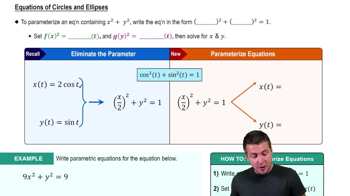
The center-radius form of a circle's equation is (x - h)² + (y - k)² = r², where (h, k) is the center and r is the radius. This form directly relates the geometric properties of the circle to its algebraic representation, making it easier to write the equation from a graph.
Recommended video:
Equations of Circles & Ellipses
Identifying the Center from a Graph
The center of a circle on a graph is the point equidistant from all points on the circle's circumference. It can be found by locating the midpoint of the diameter or by observing the symmetry of the circle along the x and y axes.
Recommended video:
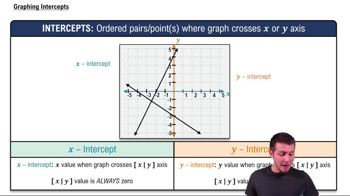
Graphing Intercepts
Determining the Radius from a Graph
The radius is the distance from the center of the circle to any point on its edge. On a graph, this can be measured by counting the units between the center and a point on the circle along the x or y axis, or by using the distance formula if coordinates are known.
Recommended video:
Graphing Intercepts
Related Practice
Textbook Question
9
views
Textbook Question
For each function, find (a) ƒ(2) and (b) ƒ(-1). See Example 7. ƒ = {(2, 5), (3, 9), (-1, 11), (5, 3)}
Textbook Question
For each function, find (a) ƒ(2) and (b) ƒ(-1). See Example 7.
Textbook Question
Use the product and quotient rules for radicals to rewrite each expression. See Example 4. √4⁄50
5
views
Textbook Question
Sea level refers to the surface of the ocean. The depth of a body of water can be expressed as a negative number, representing average depth in feet below sea level. The altitude of a mountain can be expressed as a positive number, indicating its height in feet above sea level. The table gives selected depths and altitudes. List the bodies of water in order, deepest to shallowest.
1
views
Textbook Question
Find each product. See Example 5. (q - 2)⁴
2
views