Concept Check Plot each point, and then plot the points that are symmetric to the given point with point with respect to the (a) x-axis (5, -3)
Ch. R - Algebra Review
Chapter 1, Problem 33c
Concept Check Plot each point, and then plot the points that are symmetric to the given point with point with respect to the (c) origin. (5, -3)
Verified step by step guidance1
Understand that symmetry with respect to the origin means reflecting the point through the origin, which changes both the x-coordinate and y-coordinate to their opposites.
Start by plotting the original point (5, -3) on the coordinate plane: move 5 units to the right on the x-axis and 3 units down on the y-axis.
To find the point symmetric to (5, -3) with respect to the origin, apply the transformation: \((x, y) \rightarrow (-x, -y)\).
Calculate the symmetric point by changing the signs of both coordinates: \((-5, 3)\).
Plot the symmetric point (-5, 3) on the coordinate plane: move 5 units to the left on the x-axis and 3 units up on the y-axis.

Verified video answer for a similar problem:
This video solution was recommended by our tutors as helpful for the problem above.
Was this helpful?
Key Concepts
Here are the essential concepts you must grasp in order to answer the question correctly.
Coordinate Plane and Plotting Points
The coordinate plane is a two-dimensional surface defined by the x-axis (horizontal) and y-axis (vertical). Each point is represented by an ordered pair (x, y), where x indicates the horizontal position and y the vertical position. Plotting a point involves locating its position based on these coordinates.
Recommended video:
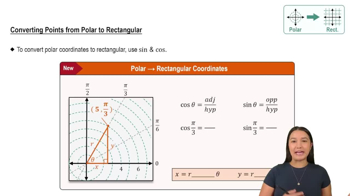
Convert Points from Polar to Rectangular
Symmetry with Respect to the Origin
Symmetry about the origin means that for any point (x, y), its symmetric point is (-x, -y). This reflects the point through the origin, effectively rotating it 180 degrees around (0,0). It is a key concept in understanding transformations in the coordinate plane.
Recommended video:
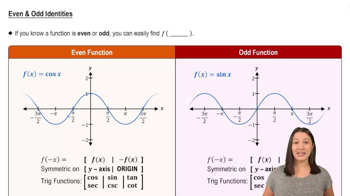
Even and Odd Identities
Reflection and Transformation in the Coordinate Plane
Reflection involves flipping a point across a line or point, creating a mirror image. In this case, reflecting a point about the origin is a specific transformation that changes the sign of both coordinates. Understanding these transformations helps in visualizing geometric relationships and solving related problems.
Recommended video:
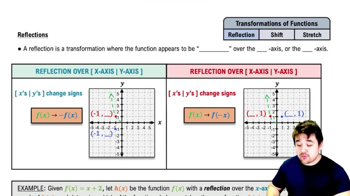
Reflections of Functions
Related Practice
Textbook Question
7
views
Textbook Question
Let A = {-6, -12⁄4, -5⁄8, -√3, 0, ¼, 1, 2π, 3, √12}. List all the elements of A that belong to each set. Irrational numbers
Textbook Question
Determine whether each relation defines y as a function of x. Give the domain and range. See Example 5. y = 2x - 5
1
views
Textbook Question
Concept Check Plot each point, and then plot the points that are symmetric to the given point with point with respect to the (b) y-axis (5, -3)
Textbook Question
For each equation, (a) give a table with at least three ordered pairs that are solutions, and (b) graph the equation. See Examples 3 and 4.
y = √(x - 3)
Textbook Question
Let A = {-6, -12⁄4, -5⁄8, -√3, 0, ¼, 1, 2π, 3, √12}. List all the elements of A that belong to each set. Real numbers