Ch. 7 - Applications of Trigonometry and Vectors
Lial - Trigonometry 12th Edition
Lial12th EditionTrigonometryISBN: 9780136552161Not the one you use?Change textbook
Chapter 8, Problem 1

Use the law of sines to find the indicated part of each triangle ABC.


Find b if C = 74.2°, c = 96.3 m, B = 39.5

Verified step by step guidance
1
Identify the known parts of the triangle: angle C = 74.2°, side c = 96.3 m (opposite angle C), and angle B = 39.5°. We need to find side b, which is opposite angle B.
Recall the Law of Sines formula: \(\frac{a}{\sin A} = \frac{b}{\sin B} = \frac{c}{\sin C}\). We will use the relationship between sides b and c and their opposite angles B and C.
Set up the proportion using the Law of Sines: \(\frac{b}{\sin B} = \frac{c}{\sin C}\). Substitute the known values: \(\frac{b}{\sin 39.5^\circ} = \frac{96.3}{\sin 74.2^\circ}\).
Solve for side b by multiplying both sides by \(\sin 39.5^\circ\): \(b = \frac{96.3 \times \sin 39.5^\circ}{\sin 74.2^\circ}\).
Calculate the sine values for angles 39.5° and 74.2°, then perform the multiplication and division to find the length of side b.

Verified video answer for a similar problem:

This video solution was recommended by our tutors as helpful for the problem above.
Was this helpful?

Key Concepts

Here are the essential concepts you must grasp in order to answer the question correctly.

Law of Sines

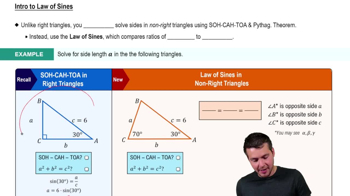
The Law of Sines relates the sides and angles of a triangle by stating that the ratio of the length of a side to the sine of its opposite angle is constant for all three sides. It is expressed as (a/sin A) = (b/sin B) = (c/sin C), and is useful for solving triangles when given two angles and one side or two sides and a non-included angle.
Recommended video:
4:27
Intro to Law of Sines

Triangle Angle Sum Property

The sum of the interior angles in any triangle is always 180°. This property allows you to find the missing angle when two angles are known, which is essential before applying the Law of Sines if not all angles are given.
Recommended video:
4:47
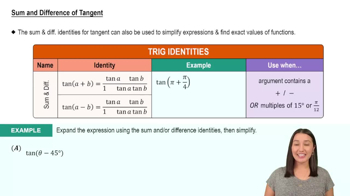
Sum and Difference of Tangent

Solving for Unknown Sides

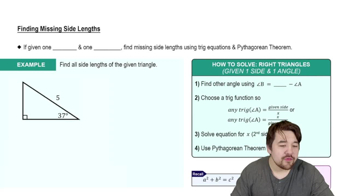
Once the Law of Sines is set up, you can solve for an unknown side by rearranging the formula to isolate the side length. This involves substituting known angle measures and side lengths, then calculating the unknown side using algebraic manipulation and trigonometric values.
Recommended video:
4:18
Finding Missing Side Lengths