Ch. 7 - Applications of Trigonometry and Vectors
Lial - Trigonometry 12th Edition
Lial12th EditionTrigonometryISBN: 9780136552161Not the one you use?Change textbook
Chapter 8, Problem 30b

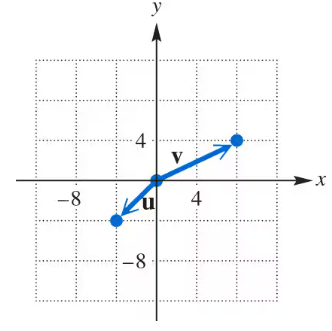
Use the figure to find each vector: u - v. Use vector notation as in Example 4.

Verified step by step guidance
1
Identify the components of vectors \( \mathbf{u} \) and \( \mathbf{v} \) from the figure. Typically, each vector can be expressed in component form as \( \mathbf{u} = \langle u_x, u_y \rangle \) and \( \mathbf{v} = \langle v_x, v_y \rangle \), where \( u_x \) and \( u_y \) are the horizontal and vertical components of \( \mathbf{u} \), and similarly for \( \mathbf{v} \).
Recall that vector subtraction \( \mathbf{u} - \mathbf{v} \) is performed by subtracting the corresponding components of \( \mathbf{v} \) from \( \mathbf{u} \). This means \( \mathbf{u} - \mathbf{v} = \langle u_x - v_x, u_y - v_y \rangle \).
Calculate the horizontal component of \( \mathbf{u} - \mathbf{v} \) by subtracting the horizontal component of \( \mathbf{v} \) from that of \( \mathbf{u} \): \( u_x - v_x \).
Calculate the vertical component of \( \mathbf{u} - \mathbf{v} \) by subtracting the vertical component of \( \mathbf{v} \) from that of \( \mathbf{u} \): \( u_y - v_y \).
Write the resulting vector in component form as \( \mathbf{u} - \mathbf{v} = \langle u_x - v_x, u_y - v_y \rangle \), which is the vector notation requested.

Verified video answer for a similar problem:

This video solution was recommended by our tutors as helpful for the problem above.
Was this helpful?

Key Concepts

Here are the essential concepts you must grasp in order to answer the question correctly.

Vector Subtraction

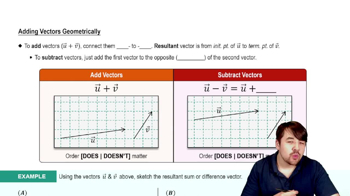
Vector subtraction involves finding the difference between two vectors by reversing the direction of the vector to be subtracted and then adding it to the first vector. Algebraically, u - v is equivalent to u + (-v), where -v is the vector v with its direction reversed.
Recommended video:
05:29
Adding Vectors Geometrically

Vector Notation

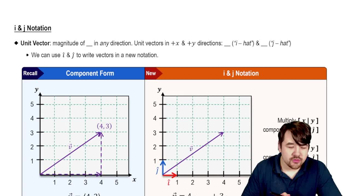
Vector notation typically represents vectors as ordered pairs or components, such as u = <x, y>. This notation allows for straightforward algebraic operations like addition and subtraction by working component-wise, which is essential for expressing the result of u - v clearly.
Recommended video:
06:01
i & j Notation

Graphical Representation of Vectors

Vectors can be represented graphically as directed line segments with magnitude and direction. Understanding how to visualize vector subtraction on a graph helps in interpreting the problem and verifying the algebraic result by drawing vectors u, v, and u - v accordingly.
Recommended video:
04:19
Finding Direction of a Vector Example 1