Ch. 7 - Applications of Trigonometry and Vectors
Lial - Trigonometry 12th Edition
Lial12th EditionTrigonometryISBN: 9780136552161Not the one you use?Change textbook
Chapter 8, Problem 16

Solve each triangle ABC.


<IMAGE>

Verified step by step guidance
1
Identify the given elements in triangle ABC, such as known sides and angles. Typically, a triangle problem provides either two sides and an included angle (SAS), two angles and a side (AAS or ASA), or three sides (SSS). Understanding what is given is crucial to decide which trigonometric laws to apply.
If two angles are given, use the fact that the sum of angles in a triangle is 180 degrees to find the third angle: \(\text{Angle}_C = 180^\circ - \text{Angle}_A - \text{Angle}_B\).
Apply the Law of Sines if you have an angle-side opposite pair and need to find other sides or angles. The Law of Sines states: \(\frac{a}{\sin(\text{Angle}_A)} = \frac{b}{\sin(\text{Angle}_B)} = \frac{c}{\sin(\text{Angle}_C)}\), where \(a\), \(b\), and \(c\) are the sides opposite to angles \(A\), \(B\), and \(C\) respectively.
If you have two sides and the included angle (SAS), use the Law of Cosines to find the third side: \(c^2 = a^2 + b^2 - 2ab \cos(\text{Angle}_C)\). Then, use the Law of Sines or Cosines to find the remaining angles.
Once all sides and angles are found, verify your answers by checking that the sum of angles is 180 degrees and that the sides satisfy the triangle inequality. This ensures the solution is consistent and correct.

Verified video answer for a similar problem:

This video solution was recommended by our tutors as helpful for the problem above.
Was this helpful?

Key Concepts

Here are the essential concepts you must grasp in order to answer the question correctly.

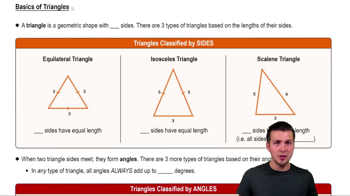
Triangle Classification and Properties

Understanding the types of triangles (right, acute, obtuse) and their properties is essential. This helps in determining which trigonometric rules or formulas apply when solving for unknown sides or angles.
Recommended video:
4:42
Review of Triangles

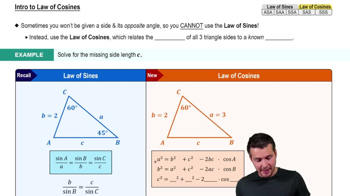
Law of Sines and Law of Cosines

These laws relate the sides and angles of any triangle. The Law of Sines is useful when two angles and one side or two sides and a non-included angle are known, while the Law of Cosines applies when two sides and the included angle or all three sides are known.
Recommended video:
4:35
Intro to Law of Cosines

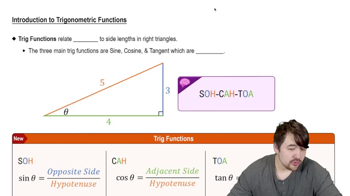
Trigonometric Ratios and Angle Measures

Familiarity with sine, cosine, and tangent ratios and how to use them to find missing sides or angles is crucial. Also, understanding angle measures in degrees or radians and how to convert between them aids in accurate calculations.
Recommended video:
6:04
Introduction to Trigonometric Functions