Ch. 6 - Inverse Circular Functions and Trigonometric Equations
Lial - Trigonometry 12th Edition
Lial12th EditionTrigonometryISBN: 9780136552161Not the one you use?Change textbook
Chapter 7, Problem 11

Use the unit circle shown here to solve each simple trigonometric equation. If the variable is x, then solve over [0, 2π). If the variable is θ, then solve over [0°, 360°).                     
<IMAGE>
sin θ = ―√2/2

Verified step by step guidance
1
Identify the trigonometric equation given: \(\sin \theta = -\frac{\sqrt{2}}{2}\). We need to find all angles \(\theta\) in the interval \([0^\circ, 360^\circ)\) where the sine value equals \(-\frac{\sqrt{2}}{2}\).
Recall that \(\sin \theta = \pm \frac{\sqrt{2}}{2}\) corresponds to special angles related to \(45^\circ\) or \(\frac{\pi}{4}\) radians. Since the sine is negative, we focus on angles where the sine value is negative, which occurs in the third and fourth quadrants.
Determine the reference angle. The reference angle \(\alpha\) is the acute angle whose sine is \(\frac{\sqrt{2}}{2}\). This angle is \(45^\circ\) (or \(\frac{\pi}{4}\) radians).
Find the angles in the third and fourth quadrants by adding the reference angle to the appropriate quadrant angles: - Third quadrant angle: \(180^\circ + 45^\circ = 225^\circ\) - Fourth quadrant angle: \(360^\circ - 45^\circ = 315^\circ\)
Write the solution set as \(\theta = 225^\circ, 315^\circ\) within the interval \([0^\circ, 360^\circ)\).

Verified video answer for a similar problem:

This video solution was recommended by our tutors as helpful for the problem above.
Was this helpful?

Key Concepts

Here are the essential concepts you must grasp in order to answer the question correctly.

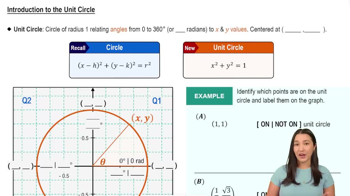
Unit Circle and Angle Measurement

The unit circle is a circle with radius 1 centered at the origin of the coordinate plane. Angles on the unit circle can be measured in radians (0 to 2π) or degrees (0° to 360°). Each point on the circle corresponds to (cos θ, sin θ), linking angle measures to trigonometric values.
Recommended video:
06:11
Introduction to the Unit Circle

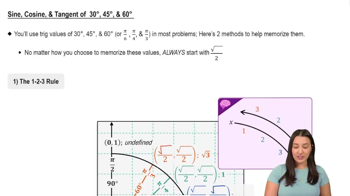
Sine Function and Its Values

The sine of an angle θ corresponds to the y-coordinate of the point on the unit circle at that angle. Knowing common sine values, such as sin 45° = √2/2, helps identify angles where sine equals specific values, including negative values which occur in certain quadrants.
Recommended video:
5:08
Sine, Cosine, & Tangent of 30°, 45°, & 60°

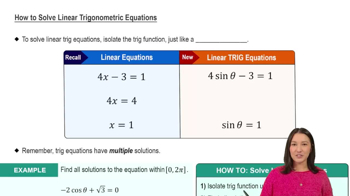
Solving Trigonometric Equations on a Given Interval

To solve equations like sin θ = -√2/2 over [0°, 360°), identify all angles within the interval where the sine value matches. Since sine is negative in the third and fourth quadrants, solutions must be found there, considering the reference angle associated with √2/2.
Recommended video:
4:34
How to Solve Linear Trigonometric Equations