Ch. 6 - Inverse Circular Functions and Trigonometric Equations
Lial - Trigonometry 12th Edition
Lial12th EditionTrigonometryISBN: 9780136552161Not the one you use?Change textbook
Chapter 7, Problem 6.3.12

Solve for exact solutions over the interval [0°, 360°).
sin θ/2 = -√3/2

Verified step by step guidance
1
Start by rewriting the equation: \(\frac{\sin \theta}{2} = -\frac{\sqrt{3}}{2}\). Multiply both sides by 2 to isolate \(\sin \theta\): \(\sin \theta = -\sqrt{3}\).
Recognize that the sine function has a range of \([-1, 1]\), so \(\sin \theta = -\sqrt{3}\) is not possible because \(\sqrt{3} > 1\). This suggests there might be a misunderstanding in the original equation.
Re-examine the problem statement: if the equation is \(\sin \frac{\theta}{2} = -\frac{\sqrt{3}}{2}\), then focus on solving for \(\frac{\theta}{2}\) first.
Recall that \(\sin x = -\frac{\sqrt{3}}{2}\) corresponds to angles where the sine value is negative and equal to \(-\frac{\sqrt{3}}{2}\). The reference angle for \(\sin x = \frac{\sqrt{3}}{2}\) is \(60^\circ\), so the solutions for \(\sin x = -\frac{\sqrt{3}}{2}\) are in the third and fourth quadrants: \(x = 180^\circ + 60^\circ = 240^\circ\) and \(x = 360^\circ - 60^\circ = 300^\circ\).
Set \(\frac{\theta}{2} = 240^\circ\) and \(\frac{\theta}{2} = 300^\circ\), then multiply both sides by 2 to find \(\theta\): \(\theta = 480^\circ\) and \(\theta = 600^\circ\). Since the interval is \([0^\circ, 360^\circ)\), subtract \(360^\circ\) to find equivalent angles within the interval: \(\theta = 120^\circ\) and \(\theta = 240^\circ\).

Verified video answer for a similar problem:

This video solution was recommended by our tutors as helpful for the problem above.
Was this helpful?

Key Concepts

Here are the essential concepts you must grasp in order to answer the question correctly.

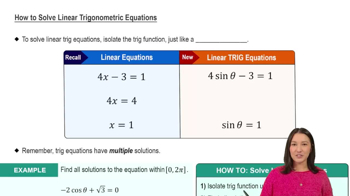
Solving Basic Trigonometric Equations

To solve equations like sin(θ/2) = -√3/2, identify the angles where the sine function equals the given value. This involves recalling the unit circle values and understanding that sine is negative in specific quadrants. Solutions are found by setting the argument (θ/2) equal to these reference angles.
Recommended video:
4:34
How to Solve Linear Trigonometric Equations

Unit Circle and Reference Angles

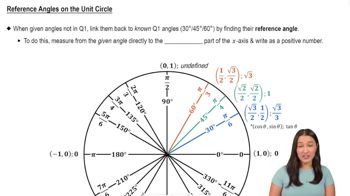
The unit circle helps determine exact sine values at standard angles. Reference angles are acute angles related to the given angle, used to find sine values in different quadrants. Since sine is negative in the third and fourth quadrants, these guide where solutions lie for sin(θ/2) = -√3/2.
Recommended video:
5:31
Reference Angles on the Unit Circle

Interval Considerations and Back-Substitution

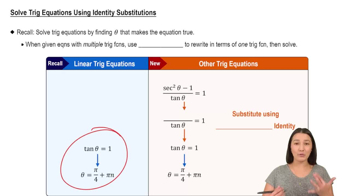
The problem restricts θ to [0°, 360°), so after solving for θ/2, multiply solutions by 2 to find θ. Ensure the final θ values fall within the given interval by considering the domain and periodicity of sine. This step is crucial to list all valid solutions without extraneous ones.
Recommended video:
04:42
Solve Trig Equations Using Identity Substitutions
Related Practice
Textbook Question

Solve each equation (x in radians and θ in degrees) for all exact solutions where appropriate. Round approximate answers in radians to four decimal places and approximate answers in degrees to the nearest tenth. Write answers using the least possible nonnegative angle measures.

5 + 5 tan² θ = 6 sec θ

Textbook Question

Answer each question.


Suppose solving a trigonometric equation for solutions over the interval [0, 2π) leads to 2x = 2π/3, 2π, 8π/3. What are the corresponding values of x?

Textbook Question

Solve each equation (x in radians and θ in degrees) for all exact solutions where appropriate. Round approximate answers in radians to four decimal places and approximate answers in degrees to the nearest tenth. Write answers using the least possible nonnegative angle measures.

6 sin² θ + sin θ = 1

Textbook Question

Solve each equation (x in radians and θ in degrees) for all exact solutions where appropriate. Round approximate answers in radians to four decimal places and approximate answers in degrees to the nearest tenth. Write answers using the least possible nonnegative angle measures.

sin x (3 sin x - 1) = 1

Textbook Question

Solve each equation (x in radians and θ in degrees) for all exact solutions where appropriate. Round approximate answers in radians to four decimal places and approximate answers in degrees to the nearest tenth. Write answers using the least possible nonnegative angle measures.


cos θ/2 = 1

Textbook Question

Solve each equation over the interval [0°, 360°). Write solutions as exact values or to the nearest tenth, as appropriate.

9 sin² θ ― 6 sin² θ = 1