Ch. 6 - Inverse Circular Functions and Trigonometric Equations
Lial - Trigonometry 12th Edition
Lial12th EditionTrigonometryISBN: 9780136552161Not the one you use?Change textbook
Chapter 7, Problem 6.2.49

Solve each equation (x in radians and θ in degrees) for all exact solutions where appropriate. Round approximate answers in radians to four decimal places and approximate answers in degrees to the nearest tenth. Write answers using the least possible nonnegative angle measures.
3 csc x― 2√3 = 0

Verified step by step guidance
1
Start by isolating the cosecant function in the equation: 3 \(\csc\) x - 2\(\sqrt{3}\) = 0. Add 2\(\sqrt{3}\) to both sides to get 3 \(\csc\) x = 2\(\sqrt{3}\).
Divide both sides of the equation by 3 to solve for \(\csc\) x: \(\csc\) x = \(\frac{2\sqrt{3}\)}{3}.
Recall that \(\csc\) x is the reciprocal of \(\sin\) x, so rewrite the equation as \(\sin\) x = \(\frac{3}{2\sqrt{3}\)}. Simplify this expression to find the exact value of \(\sin\) x.
Determine all angles x (in radians) where \(\sin\) x equals the simplified value, considering the unit circle and the range of sine function. Use the least possible nonnegative angle measures and include all solutions within one full rotation (0 to 2\(\pi\)).
For solutions in degrees (\(\theta\)), convert the radian solutions to degrees by multiplying by \(\frac{180}{\pi}\), then round approximate answers to the nearest tenth of a degree.

Verified video answer for a similar problem:

This video solution was recommended by our tutors as helpful for the problem above.
Was this helpful?

Key Concepts

Here are the essential concepts you must grasp in order to answer the question correctly.

Reciprocal Trigonometric Functions

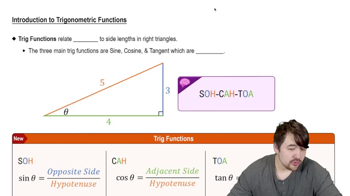
The cosecant function (csc x) is the reciprocal of the sine function, defined as csc x = 1/sin x. Understanding this relationship allows you to rewrite equations involving csc x in terms of sin x, which is often easier to solve.
Recommended video:
6:04
Introduction to Trigonometric Functions

Solving Trigonometric Equations

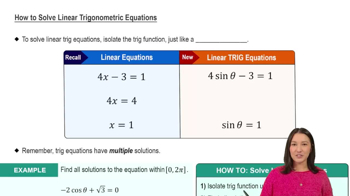
Solving trigonometric equations involves isolating the trigonometric function and finding all angle solutions within the specified domain. Since sine and cosecant are periodic, solutions repeat every 2π radians or 360 degrees, so all solutions must be expressed using general solution formulas.
Recommended video:
4:34
How to Solve Linear Trigonometric Equations

Angle Measurement and Conversion

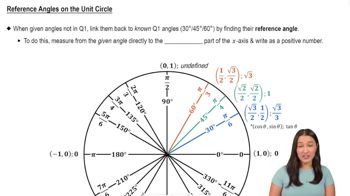
Angles can be measured in radians or degrees, and problems may require answers in either unit. Knowing how to convert between radians and degrees and how to express angles within the least nonnegative measure (0 to 2π or 0° to 360°) is essential for providing correct and standardized solutions.
Recommended video:
5:31
Reference Angles on the Unit Circle