Ch. 6 - Inverse Circular Functions and Trigonometric Equations
Lial - Trigonometry 12th Edition
Lial12th EditionTrigonometryISBN: 9780136552161Not the one you use?Change textbook
Chapter 7, Problem 6.2.43

Solve each equation over the interval [0°, 360°). Write solutions as exact values or to the nearest tenth, as appropriate.
sin² θ ― 2 sin θ + 3 = 0

Verified step by step guidance
1
Recognize that the equation is a quadratic in terms of \( \sin \theta \). Let \( x = \sin \theta \), so the equation becomes \( x^2 - 2x + 3 = 0 \).
Use the quadratic formula to solve for \( x \): \( x = \frac{2 \pm \sqrt{(-2)^2 - 4 \cdot 1 \cdot 3}}{2 \cdot 1} \).
Calculate the discriminant \( \Delta = (-2)^2 - 4 \cdot 1 \cdot 3 = 4 - 12 = -8 \). Since the discriminant is negative, there are no real solutions for \( x = \sin \theta \).
Recall that \( \sin \theta \) must be a real number between -1 and 1, so no real values of \( \theta \) satisfy the equation in the interval \( [0^\circ, 360^\circ) \).
Conclude that the equation has no solutions for \( \theta \) in the given interval because the quadratic in \( \sin \theta \) has no real roots.

Verified video answer for a similar problem:

This video solution was recommended by our tutors as helpful for the problem above.
Was this helpful?

Key Concepts

Here are the essential concepts you must grasp in order to answer the question correctly.

Solving Quadratic Equations in Trigonometric Functions

Many trigonometric equations can be rewritten as quadratic equations by substituting a trigonometric expression, such as sin θ, with a variable. This allows the use of algebraic methods like factoring or the quadratic formula to find possible values of the trigonometric function.
Recommended video:
6:24
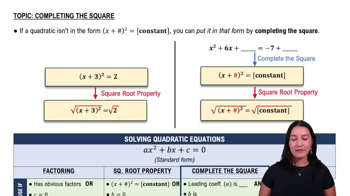
Solving Quadratic Equations by Completing the Square

Range and Values of the Sine Function

The sine function outputs values only between -1 and 1. When solving equations like sin² θ - 2 sin θ + 3 = 0, it is important to check if the solutions for sin θ fall within this range, as values outside it are not possible and thus yield no valid angle solutions.
Recommended video:
4:22
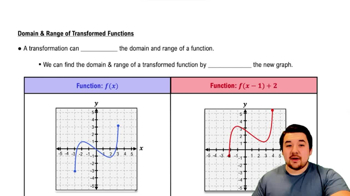
Domain and Range of Function Transformations

Finding Angles from Sine Values within a Given Interval

Once the sine values are found, the corresponding angles θ must be determined within the specified interval [0°, 360°). This involves using the inverse sine function and considering the sine function’s symmetry in the unit circle to find all valid solutions.
Recommended video:
5:08
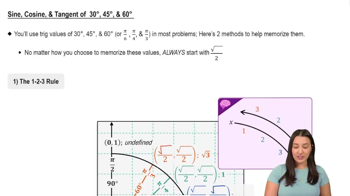
Sine, Cosine, & Tangent of 30°, 45°, & 60°
Related Practice
Textbook Question

Solve each equation (x in radians and θ in degrees) for all exact solutions where appropriate. Round approximate answers in radians to four decimal places and approximate answers in degrees to the nearest tenth. Write answers using the least possible nonnegative angle measures.

2 cos² x + cos x ― 1 = 0

Textbook Question

The following equations cannot be solved by algebraic methods. Use a graphing calculator to find all solutions over the interval [0, 2π). Express solutions to four decimal places.

2 sin 2x ― x³ + 1 = 0

Textbook Question

Solve each equation (x in radians and θ in degrees) for all exact solutions where appropriate. Round approximate answers in radians to four decimal places and approximate answers in degrees to the nearest tenth. Write answers using the least possible nonnegative angle measures.


√2 sin 3x - 1 = 0

Textbook Question

Solve each equation (x in radians and θ in degrees) for all exact solutions where appropriate. Round approximate answers in radians to four decimal places and approximate answers in degrees to the nearest tenth. Write answers using the least possible nonnegative angle measures.


1 - sin x = cos 2x

Textbook Question

Solve each equation in x over the interval [0, 2π) and each equation in θ over the interval [0°, 360°). Give exact solutions.

sin (θ/2) = csc (θ/2)

Textbook Question

Solve each equation in x over the interval [0, 2π) and each equation in θ over the interval [0°, 360°). Give exact solutions.


2 cos 2x = √3