Ch. 6 - Inverse Circular Functions and Trigonometric Equations
Lial - Trigonometry 12th Edition
Lial12th EditionTrigonometryISBN: 9780136552161Not the one you use?Change textbook
Chapter 7, Problem 6.61

Solve each equation for x.
y = 1/2 tan (3x + 2), for x in [-2/3 - π/6, -2/3 + π/6]

Verified step by step guidance
1
Start by isolating the tangent function: multiply both sides of the equation by 2 to get \( \tan(3x + 2) = 2y \).
Next, take the inverse tangent (arctan) of both sides to solve for the angle: \( 3x + 2 = \arctan(2y) \).
Subtract 2 from both sides to isolate the term with x: \( 3x = \arctan(2y) - 2 \).
Divide both sides by 3 to solve for x: \( x = \frac{\arctan(2y) - 2}{3} \).
Ensure that the solution for x falls within the given interval \([-\frac{2}{3} - \frac{\pi}{6}, -\frac{2}{3} + \frac{\pi}{6}]\) by checking the calculated x values.

Verified video answer for a similar problem:

This video solution was recommended by our tutors as helpful for the problem above.
Was this helpful?

Key Concepts

Here are the essential concepts you must grasp in order to answer the question correctly.

Tangent Function

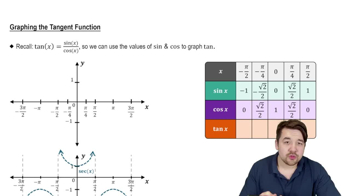
The tangent function, denoted as tan(x), is a fundamental trigonometric function defined as the ratio of the opposite side to the adjacent side in a right triangle. It is periodic with a period of π, meaning it repeats its values every π radians. Understanding the properties of the tangent function, including its asymptotes and behavior, is crucial for solving equations involving tan.
Recommended video:
5:43
Introduction to Tangent Graph

Inverse Trigonometric Functions

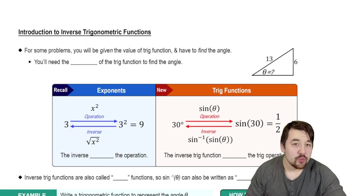
Inverse trigonometric functions, such as arctan, are used to find angles when the value of a trigonometric function is known. For example, if y = tan(x), then x = arctan(y). These functions are essential for solving equations where the variable is inside a trigonometric function, allowing us to isolate the angle and find the corresponding x values.
Recommended video:
4:28
Introduction to Inverse Trig Functions

Interval Notation

Interval notation is a mathematical notation used to represent a range of values. In this context, the interval [-2/3 - π/6, -2/3 + π/6] specifies the domain within which we are looking for solutions for x. Understanding how to interpret and work within specified intervals is important for determining valid solutions to trigonometric equations.
Recommended video:
06:01
i & j Notation
Related Practice
Textbook Question

Solve each equation (x in radians and θ in degrees) for all exact solutions where appropriate. Round approximate answers in radians to four decimal places and approximate answers in degrees to the nearest tenth. Write answers using the least possible nonnegative angle measures.

2 cos² x + cos x ― 1 = 0

Textbook Question

Solve each equation (x in radians and θ in degrees) for all exact solutions where appropriate. Round approximate answers in radians to four decimal places and approximate answers in degrees to the nearest tenth. Write answers using the least possible nonnegative angle measures.


√2 sin 3x - 1 = 0

Textbook Question

Solve each equation (x in radians and θ in degrees) for all exact solutions where appropriate. Round approximate answers in radians to four decimal places and approximate answers in degrees to the nearest tenth. Write answers using the least possible nonnegative angle measures.

cos θ + 1 = 0

Textbook Question

Solve each equation over the interval [0, 2π). Write solutions as exact values or to four decimal places, as appropriate

tan 2x + sec 2x = 3

Textbook Question

Solve each equation (x in radians and θ in degrees) for all exact solutions where appropriate. Round approximate answers in radians to four decimal places and approximate answers in degrees to the nearest tenth. Write answers using the least possible nonnegative angle measures.


3 csc² x/2 = 2 sec x

Textbook Question

Solve for exact solutions over the interval [0°, 360°).

cos θ/2 = -1/2