Ch. 6 - Inverse Circular Functions and Trigonometric Equations
Lial - Trigonometry 12th Edition
Lial12th EditionTrigonometryISBN: 9780136552161Not the one you use?Change textbook
Chapter 7, Problem 15

Find the exact value of each real number y if it exists. Do not use a calculator.
y = cos⁻¹ (―1)

Verified step by step guidance
1
Recall that the function \( \cos^{-1}(x) \), also known as arccosine, gives the angle \( y \) in the range \( 0 \leq y \leq \pi \) such that \( \cos(y) = x \).
Identify the value inside the arccosine function: here, \( x = -1 \). So we need to find \( y \) such that \( \cos(y) = -1 \).
Think about the unit circle and the cosine values at key angles between \( 0 \) and \( \pi \). Cosine corresponds to the x-coordinate on the unit circle.
Recall that \( \cos(\pi) = -1 \), and since \( \pi \) is within the principal range of arccosine, this is the angle we are looking for.
Therefore, the exact value of \( y = \cos^{-1}(-1) \) is \( y = \pi \).

Verified video answer for a similar problem:

This video solution was recommended by our tutors as helpful for the problem above.
Was this helpful?

Key Concepts

Here are the essential concepts you must grasp in order to answer the question correctly.

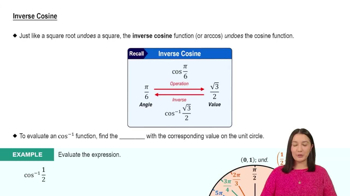
Inverse Cosine Function (cos⁻¹ or arccos)

The inverse cosine function, denoted as cos⁻¹ or arccos, returns the angle whose cosine value is a given number. It is defined for inputs between -1 and 1 and outputs angles in the range [0, π] radians (or [0°, 180°]). Understanding this range is crucial for finding exact angle values.
Recommended video:
4:49
Inverse Cosine

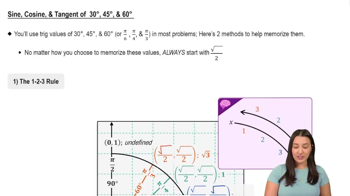
Cosine Values of Special Angles

Certain angles have well-known cosine values, such as cos(0) = 1, cos(π/2) = 0, and cos(π) = -1. Recognizing these special angles helps in determining the exact value of inverse trigonometric functions without a calculator.
Recommended video:
5:08
Sine, Cosine, & Tangent of 30°, 45°, & 60°

Exact Values vs. Approximate Values

In trigonometry, exact values are expressed in terms of well-known constants like π or simple fractions, rather than decimal approximations. For inverse cosine, this means identifying the angle in radians or degrees that precisely corresponds to the given cosine value.
Recommended video:
6:04
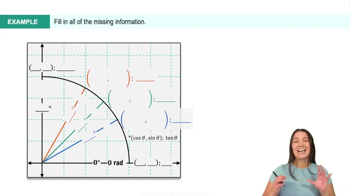
Example 1