Ch. 6 - Inverse Circular Functions and Trigonometric Equations
Lial - Trigonometry 12th Edition
Lial12th EditionTrigonometryISBN: 9780136552161Not the one you use?Change textbook
Chapter 7, Problem 25

Find the exact value of each real number y if it exists. Do not use a calculator.
y = sin⁻¹ √3

Verified step by step guidance
1
Recall the domain of the inverse sine function \(\sin^{-1}(x)\), which is \([-1, 1]\). This means the input to \(\sin^{-1}\) must be between \(-1\) and \(1\) inclusive.
Check the value inside the inverse sine function: \(\sqrt{3}\). Since \(\sqrt{3} \approx 1.732\), it is greater than \(1\).
Since \(\sqrt{3}\) is outside the domain of \(\sin^{-1}\), there is no real number \(y\) such that \(y = \sin^{-1}(\sqrt{3})\).
Therefore, the problem has no solution in the set of real numbers because the input to \(\sin^{-1}\) is invalid.
If you want to explore complex solutions, that would involve extending the inverse sine function to complex numbers, but for real numbers, no solution exists.

Verified video answer for a similar problem:

This video solution was recommended by our tutors as helpful for the problem above.
Was this helpful?

Key Concepts

Here are the essential concepts you must grasp in order to answer the question correctly.

Inverse Sine Function (sin⁻¹ or arcsin)

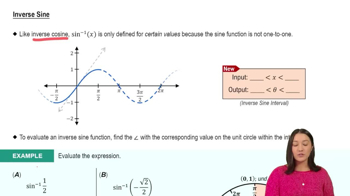
The inverse sine function, sin⁻¹(x), returns the angle whose sine is x. Its output range is limited to [-π/2, π/2] to ensure it is a function. Understanding this helps find the angle y such that sin(y) equals the given value.
Recommended video:
4:03
Inverse Sine

Domain of the Sine Function and Its Inverse

The sine function outputs values only between -1 and 1, so the input to sin⁻¹ must lie within this range. Since √3 is approximately 1.732, which is outside this domain, no real y satisfies sin(y) = √3, indicating no real solution exists.
Recommended video:
4:03
Inverse Sine

Exact Values of Sine for Special Angles

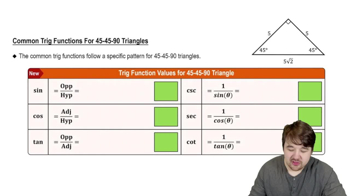
Common exact sine values include sin(π/6) = 1/2, sin(π/4) = √2/2, and sin(π/3) = √3/2. Recognizing these helps identify if the given value corresponds to a known angle. Since √3 is not among these values, it further confirms no exact real angle exists for sin⁻¹(√3).
Recommended video:
3:28
Common Trig Functions For 45-45-90 Triangles