Ch. 6 - Inverse Circular Functions and Trigonometric Equations
Lial - Trigonometry 12th Edition
Lial12th EditionTrigonometryISBN: 9780136552161Not the one you use?Change textbook
Chapter 7, Problem 31

Find the exact value of each real number y if it exists. Do not use a calculator.
y = arcsec (2√3)/3

Verified step by step guidance
1
Recall the definition of the arcsecant function: \(y = \arcsec(x)\) means \(\sec(y) = x\) and \(y\) lies in the domain of the arcsec function, typically \([0, \pi]\) excluding \(\frac{\pi}{2}\).
Set up the equation from the problem: \(\sec(y) = \frac{2\sqrt{3}}{3}\).
Use the identity \(\sec(y) = \frac{1}{\cos(y)}\) to rewrite the equation as \(\frac{1}{\cos(y)} = \frac{2\sqrt{3}}{3}\).
Solve for \(\cos(y)\) by taking the reciprocal: \(\cos(y) = \frac{3}{2\sqrt{3}}\).
Simplify \(\cos(y)\) and then determine the angle \(y\) in the interval \([0, \pi]\) (excluding \(\frac{\pi}{2}\)) whose cosine matches this value, using known special angles and exact values.

Verified video answer for a similar problem:

This video solution was recommended by our tutors as helpful for the problem above.
Was this helpful?

Key Concepts

Here are the essential concepts you must grasp in order to answer the question correctly.

Definition of the Arcsecant Function

The arcsecant function, denoted as arcsec(x), is the inverse of the secant function. It returns the angle whose secant is x. Since sec(θ) = 1/cos(θ), arcsec(x) finds θ such that sec(θ) = x, with θ typically in the range [0, π] excluding π/2.
Recommended video:
5:57
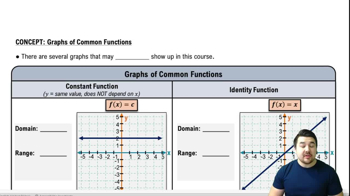
Graphs of Common Functions

Relationship Between Secant and Cosine

Secant is the reciprocal of cosine, so sec(θ) = 1/cos(θ). To find an angle from a secant value, convert it to cosine by cos(θ) = 1/sec(θ). This relationship helps in identifying the angle by comparing cosine values to known special angles.
Recommended video:
6:22
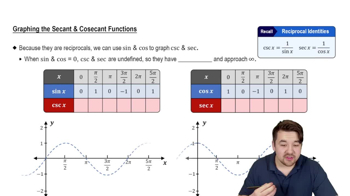
Graphs of Secant and Cosecant Functions

Exact Values of Trigonometric Functions for Special Angles

Certain angles like π/6, π/4, and π/3 have well-known exact trigonometric values involving √2 and √3. Recognizing these values allows one to find exact angles without a calculator by matching the given secant value to the reciprocal of a known cosine value.
Recommended video:
6:04
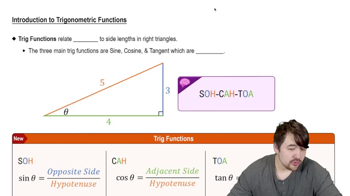
Introduction to Trigonometric Functions