Ch. 6 - Inverse Circular Functions and Trigonometric Equations
Lial - Trigonometry 12th Edition
Lial12th EditionTrigonometryISBN: 9780136552161Not the one you use?Change textbook
Chapter 7, Problem 47

Find the degree measure of θ if it exists. Do not use a calculator.
θ = sin⁻¹ 2

Verified step by step guidance
1
Recall the definition of the inverse sine function, \(\sin^{-1} x\), which gives the angle \(\theta\) such that \(\sin \theta = x\) and \(\theta\) lies within the range \([-90^\circ, 90^\circ]\) (or \([-\frac{\pi}{2}, \frac{\pi}{2}]\)$).
Understand the domain of the sine function: since \(\sin \theta\) can only take values between \(-1\) and \(1\) for real angles \(\theta\), the input to \(\sin^{-1}\) must be within this range.
Check the given value inside the inverse sine: here, it is \(2\), which is outside the domain \([-1, 1]\).
Since \(2\) is not in the domain of the inverse sine function, there is no real angle \(\theta\) such that \(\sin \theta = 2\).
Therefore, conclude that \(\theta = \sin^{-1} 2\) does not exist as a real number (no degree measure satisfies this).

Verified video answer for a similar problem:

This video solution was recommended by our tutors as helpful for the problem above.
Was this helpful?

Key Concepts

Here are the essential concepts you must grasp in order to answer the question correctly.

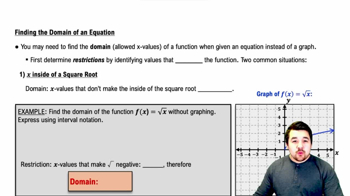
Domain of the Sine Function

The sine function outputs values only between -1 and 1 for real angles. Any input outside this range, such as 2, is not possible for sine, meaning sin⁻¹(2) does not correspond to a real angle.
Recommended video:
3:43
Finding the Domain of an Equation

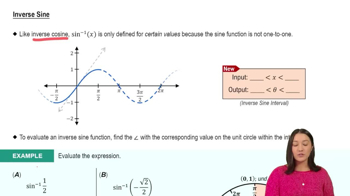
Inverse Sine Function (Arcsin)

The inverse sine function, sin⁻¹(x), returns the angle whose sine is x, but only if x is within the domain [-1, 1]. It is used to find angles from sine values, but it is undefined for values outside this range.
Recommended video:
4:03
Inverse Sine

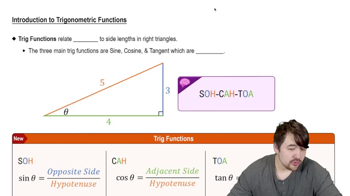
Understanding Restrictions in Trigonometric Functions

Trigonometric functions have specific domains and ranges that limit their outputs and inputs. Recognizing these restrictions helps determine whether an expression like sin⁻¹(2) has a valid solution or not.
Recommended video:
6:04
Introduction to Trigonometric Functions