Ch. 5 - Trigonometric Identities
Lial - Trigonometry 12th Edition
Lial12th EditionTrigonometryISBN: 9780136552161Not the one you use?Change textbook
Chapter 6, Problem 5.80

Verify that each equation is an identity.
(1 + sin x + cos x)² = 2(1 + sin x) (1 + cos x)

Verified step by step guidance
1
Start by expanding the left side of the equation: \((1 + \sin x + \cos x)^2\). Use the formula \((a + b + c)^2 = a^2 + b^2 + c^2 + 2ab + 2ac + 2bc\).
Calculate each term: \(a^2 = 1^2 = 1\), \(b^2 = (\sin x)^2 = \sin^2 x\), \(c^2 = (\cos x)^2 = \cos^2 x\), \(2ab = 2 \cdot 1 \cdot \sin x = 2\sin x\), \(2ac = 2 \cdot 1 \cdot \cos x = 2\cos x\), \(2bc = 2 \cdot \sin x \cdot \cos x = 2\sin x \cos x\).
Combine these terms to get: \(1 + \sin^2 x + \cos^2 x + 2\sin x + 2\cos x + 2\sin x \cos x\).
Use the Pythagorean identity \(\sin^2 x + \cos^2 x = 1\) to simplify: \(1 + 1 + 2\sin x + 2\cos x + 2\sin x \cos x = 2 + 2\sin x + 2\cos x + 2\sin x \cos x\).
Now expand the right side: \(2(1 + \sin x)(1 + \cos x) = 2((1 + \sin x) + (1 + \sin x)\cos x) = 2(1 + \sin x + \cos x + \sin x \cos x)\). Simplify to see if both sides are equal.

Verified video answer for a similar problem:

This video solution was recommended by our tutors as helpful for the problem above.
Was this helpful?

Key Concepts

Here are the essential concepts you must grasp in order to answer the question correctly.

Trigonometric Identities

Trigonometric identities are equations that hold true for all values of the variable within a certain domain. Common identities include the Pythagorean identities, reciprocal identities, and angle sum/difference identities. Understanding these identities is crucial for simplifying trigonometric expressions and verifying equations.
Recommended video:
5:32
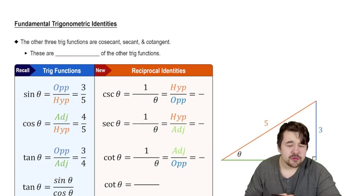
Fundamental Trigonometric Identities

Algebraic Expansion

Algebraic expansion involves applying the distributive property to multiply expressions, such as binomials. In the context of the given equation, expanding (1 + sin x + cos x)² requires using the formula (a + b)² = a² + 2ab + b², which helps in simplifying the left-hand side of the equation for comparison with the right-hand side.
Recommended video:
04:12
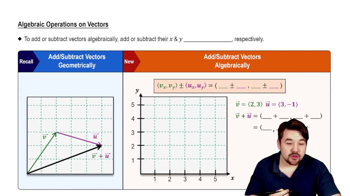
Algebraic Operations on Vectors

Factoring

Factoring is the process of breaking down an expression into simpler components, or factors, that can be multiplied to obtain the original expression. In the context of verifying identities, recognizing common factors on both sides of the equation can simplify the verification process and help establish equality between the two sides.
Recommended video:
6:08
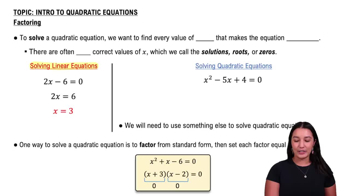
Factoring