Ch. 5 - Trigonometric Identities
Lial - Trigonometry 12th Edition
Lial12th EditionTrigonometryISBN: 9780136552161Not the one you use?Change textbook
Chapter 6, Problem 5.RE.30c

Use the given information to find tan(x + y).
sin y = - 2/3, cos x = -1/5, x in quadrant II, y in quadrant III

Verified step by step guidance
1
Identify the given information and the goal: We need to find \(\tan(x + y)\) given \(\sin y = -\frac{2}{3}\), \(\cos x = -\frac{1}{5}\), with \(x\) in quadrant II and \(y\) in quadrant III.
Recall the formula for the tangent of a sum: \(\tan(x + y) = \frac{\tan x + \tan y}{1 - \tan x \tan y}\).
Find \(\sin x\) using the Pythagorean identity \(\sin^2 x + \cos^2 x = 1\). Since \(\cos x = -\frac{1}{5}\) and \(x\) is in quadrant II (where sine is positive), calculate \(\sin x = +\sqrt{1 - \left(-\frac{1}{5}\right)^2}\).
Find \(\cos y\) using the Pythagorean identity \(\sin^2 y + \cos^2 y = 1\). Since \(\sin y = -\frac{2}{3}\) and \(y\) is in quadrant III (where cosine is negative), calculate \(\cos y = -\sqrt{1 - \left(-\frac{2}{3}\right)^2}\).
Calculate \(\tan x = \frac{\sin x}{\cos x}\) and \(\tan y = \frac{\sin y}{\cos y}\), then substitute these values into the formula \(\tan(x + y) = \frac{\tan x + \tan y}{1 - \tan x \tan y}\) to find the expression for \(\tan(x + y)\).

Verified video answer for a similar problem:

This video solution was recommended by our tutors as helpful for the problem above.
Was this helpful?

Key Concepts

Here are the essential concepts you must grasp in order to answer the question correctly.

Trigonometric Identities for Sum of Angles

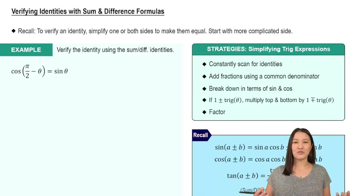
The tangent of a sum, tan(x + y), can be found using the identity tan(x + y) = (tan x + tan y) / (1 - tan x * tan y). This formula allows combining the tangents of individual angles to find the tangent of their sum.
Recommended video:
2:25
Verifying Identities with Sum and Difference Formulas

Determining Signs of Trigonometric Functions in Quadrants

The signs of sine, cosine, and tangent depend on the quadrant of the angle. In quadrant II, sine is positive and cosine is negative; in quadrant III, both sine and cosine are negative. Correct sign assignment is crucial for accurate calculations.
Recommended video:
6:04
Introduction to Trigonometric Functions

Finding Missing Trigonometric Ratios Using Pythagorean Identity

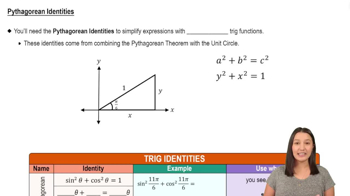
Given one trigonometric ratio (like sin y or cos x), the other ratios can be found using the Pythagorean identity sin²θ + cos²θ = 1. This helps determine unknown values such as cos y or sin x, essential for calculating tan x and tan y.
Recommended video:
6:25
Pythagorean Identities