Ch. 5 - Trigonometric Identities
Lial - Trigonometry 12th Edition
Lial12th EditionTrigonometryISBN: 9780136552161Not the one you use?Change textbook
Chapter 6, Problem 5.RE.38

Use the given information to find each of the following.
sin A/2, given cos A/2 = - 3, 90° < A < 180°

Verified step by step guidance
1
First, recognize that the problem gives you \( \cos \frac{A}{2} = -3 \) and the angle \( A \) is between 90° and 180°. Since \( \cos \frac{A}{2} \) must be between -1 and 1 for real angles, check if the given value is valid or if there might be a typo or misunderstanding in the problem statement.
Assuming the value is valid or corrected, recall the Pythagorean identity for sine and cosine: \( \sin^2 \theta + \cos^2 \theta = 1 \). Here, \( \theta = \frac{A}{2} \). Use this to express \( \sin \frac{A}{2} \) in terms of \( \cos \frac{A}{2} \):
\[ \sin \frac{A}{2} = \pm \sqrt{1 - \cos^2 \frac{A}{2}} \]
Determine the correct sign (positive or negative) for \( \sin \frac{A}{2} \) by considering the quadrant in which \( \frac{A}{2} \) lies. Since \( 90^\circ < A < 180^\circ \), then \( 45^\circ < \frac{A}{2} < 90^\circ \), which places \( \frac{A}{2} \) in the first quadrant where sine is positive.
Finally, substitute the value of \( \cos \frac{A}{2} \) into the formula and simplify under the square root to find \( \sin \frac{A}{2} \). Remember to choose the positive root based on the quadrant analysis.

Verified video answer for a similar problem:

This video solution was recommended by our tutors as helpful for the problem above.
Was this helpful?

Key Concepts

Here are the essential concepts you must grasp in order to answer the question correctly.

Half-Angle Identities

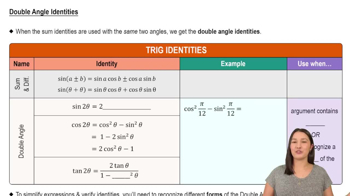
Half-angle identities relate the trigonometric functions of half an angle to those of the original angle. For sine and cosine, these identities help find values like sin(A/2) or cos(A/2) using known values of cos(A) or sin(A). They are essential for solving problems involving angles divided by two.
Recommended video:
05:06
Double Angle Identities

Sign Determination in Quadrants

The sign of trigonometric functions depends on the quadrant in which the angle lies. Since A is between 90° and 180°, A/2 lies between 45° and 90°, placing it in the first quadrant where sine is positive and cosine is positive. This helps determine the correct sign of sin(A/2) given cos(A/2).
Recommended video:
6:36
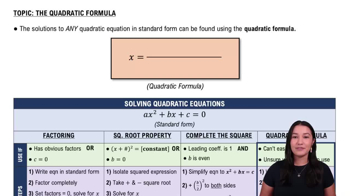
Quadratic Formula

Pythagorean Identity

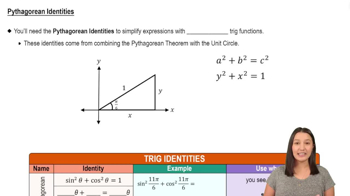
The Pythagorean identity states that sin²θ + cos²θ = 1 for any angle θ. This identity allows calculation of one trigonometric function if the other is known. In this problem, knowing cos(A/2) enables finding sin(A/2) by rearranging the identity.
Recommended video:
6:25
Pythagorean Identities