
Textbook Question
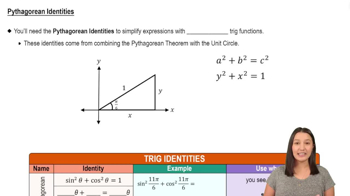
For each expression in Column I, choose the expression from Column II that completes an identity.
2. csc x = ____
II
A. sin ^2 x/cos ^2 x
B.1/(sec ^2 x)
C. sin (-x)
D. csc ^2 x-cot ^2 x + sin ^2 x
E. tan x
 Verified step by step guidance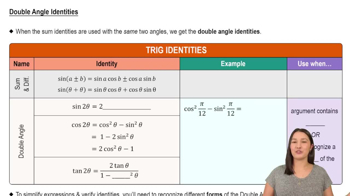
 05:06
05:06
 6:25
6:25 6:04
6:04For each expression in Column I, choose the expression from Column II that completes an identity.
2. csc x = ____
II
A. sin ^2 x/cos ^2 x
B.1/(sec ^2 x)
C. sin (-x)
D. csc ^2 x-cot ^2 x + sin ^2 x
E. tan x
For each expression in Column I, use an identity to choose an expression from Column II with the same value. Choices may be used once, more than once, or not at all.
sin 300°
Work each problem.
Find the exact values of sin x, cos x, and tan x, for x = π/12 , using
a. difference identities
b. half-angle identities.
For each expression in Column I, use an identity to choose an expression from Column II with the same value. Choices may be used once, more than once, or not at all.
-sin 35°
Use identities to write each expression in terms of sin θ and cos θ, and then simplify so that no quotients appear and all functions are of θ only.
cot(-θ)/sec(-θ)
For each expression in Column I, use an identity to choose an expression from Column II with the same value. Choices may be used once, more than once, or not at all.
cos(-55°)