Ch. 5 - Trigonometric Identities
Lial - Trigonometry 12th Edition
Lial12th EditionTrigonometryISBN: 9780136552161Not the one you use?Change textbook
Chapter 6, Problem 5.1.10

Use identities to correctly complete each sentence.


If sin θ = ⅔, then -sin(-θ) = ________________.

Verified step by step guidance
1
Recall the identity for the sine of a negative angle: \(\sin(-\theta) = -\sin(\theta)\).
Apply this identity to rewrite \(-\sin(-\theta)\) as \(-(-\sin(\theta))\).
Simplify the expression: \(-(-\sin(\theta)) = \sin(\theta)\).
Since it is given that \(\sin(\theta) = \frac{2}{3}\), substitute this value into the expression.
Therefore, \(-\sin(-\theta) = \frac{2}{3}\).

Verified video answer for a similar problem:

This video solution was recommended by our tutors as helpful for the problem above.
Was this helpful?

Key Concepts

Here are the essential concepts you must grasp in order to answer the question correctly.

Sine Function and Its Values

The sine function relates an angle in a right triangle to the ratio of the opposite side over the hypotenuse. It is defined for all real numbers and can take values between -1 and 1. Knowing the sine value of an angle helps determine related trigonometric expressions.
Recommended video:
5:08
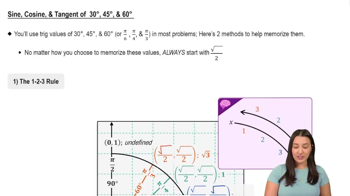
Sine, Cosine, & Tangent of 30°, 45°, & 60°

Odd Function Property of Sine

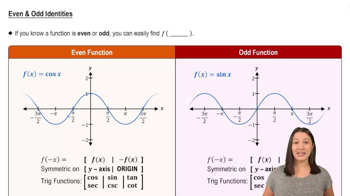
Sine is an odd function, meaning sin(-θ) = -sin(θ). This property allows us to simplify expressions involving negative angles by changing the sign of the sine value, which is crucial for evaluating expressions like -sin(-θ).
Recommended video:
06:19
Even and Odd Identities

Trigonometric Identities and Simplification

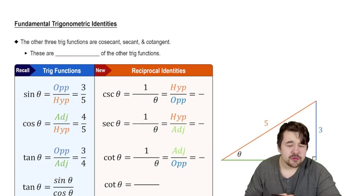
Trigonometric identities are equations involving trig functions that hold true for all angle values. Using these identities, such as the odd function property, helps simplify and correctly complete expressions by substituting known values and reducing complexity.
Recommended video:
5:32
Fundamental Trigonometric Identities