Ch. 4 - Graphs of the Circular Functions
Lial - Trigonometry 12th Edition
Lial12th EditionTrigonometryISBN: 9780136552161Not the one you use?Change textbook
Chapter 5, Problem 8

Fill in the blank(s) to correctly complete each sentence.
The graph of y = -2 + 3 cos (x - π/6) is obtained by shifting the graph of y = cos x horizontally ________ unit(s) to the __________, (right/left) stretching it vertically by a factor of ________, and then shifting it vertically ________ unit(s) __________. (up/down)

Verified step by step guidance
1
Identify the horizontal shift from the function inside the cosine: the term \( (x - \frac{\pi}{6}) \) indicates a horizontal shift. Since it is \( x - \frac{\pi}{6} \), the graph shifts \( \frac{\pi}{6} \) units to the right.
Determine the vertical stretch by looking at the coefficient multiplying the cosine function. The coefficient is 3, which means the graph is stretched vertically by a factor of 3.
Identify the vertical shift by looking at the constant term outside the cosine function. The term \( -2 \) means the graph is shifted 2 units down.
Summarize the transformations: start with the basic graph of \( y = \cos x \), shift it horizontally \( \frac{\pi}{6} \) units to the right, stretch it vertically by a factor of 3, and then shift it vertically 2 units down.
Fill in the blanks accordingly: horizontally \( \frac{\pi}{6} \) unit(s) to the right, vertically stretched by a factor of 3, and shifted vertically 2 unit(s) down.

Verified video answer for a similar problem:

This video solution was recommended by our tutors as helpful for the problem above.
Was this helpful?

Key Concepts

Here are the essential concepts you must grasp in order to answer the question correctly.

Horizontal Phase Shift in Trigonometric Functions

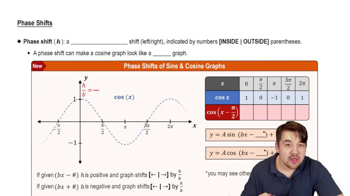
The horizontal shift of a cosine graph is determined by the value inside the function's argument, such as (x - π/6). This represents a shift to the right by π/6 units because subtracting a positive value inside the function moves the graph rightward along the x-axis.
Recommended video:
6:31
Phase Shifts

Vertical Stretching and Amplitude

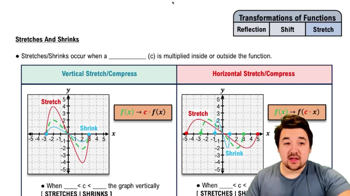
The coefficient multiplying the cosine function affects its amplitude, which is the height from the midline to a peak. A factor of 3 stretches the graph vertically by 3 times, making peaks and troughs three times farther from the midline compared to the basic cosine graph.
Recommended video:
6:02
Stretches and Shrinks of Functions

Vertical Shift of Trigonometric Graphs

Adding or subtracting a constant outside the cosine function shifts the graph vertically. In y = -2 + 3 cos(x - π/6), the -2 shifts the entire graph down by 2 units, moving the midline and all points accordingly along the y-axis.
Recommended video:
6:31
Phase Shifts