Ch. 3 - Radian Measure and The Unit Circle
Lial - Trigonometry 12th Edition
Lial12th EditionTrigonometryISBN: 9780136552161Not the one you use?Change textbook
Chapter 4, Problem 57

Work each problem. See Example 5. Angle Measure Find the measure (in radians) of a central angle of a sector of area 16 in² a circle of radius 3.0 in.

Verified step by step guidance
1
Recall the formula for the area of a sector of a circle: \(A = \frac{1}{2} r^{2} \theta\), where \(A\) is the area of the sector, \(r\) is the radius, and \(\theta\) is the central angle in radians.
Identify the given values: the area \(A = 16\) in² and the radius \(r = 3.0\) in.
Substitute the known values into the formula: \(16 = \frac{1}{2} \times (3.0)^{2} \times \theta\).
Simplify the expression on the right side: calculate \(\frac{1}{2} \times 9 = 4.5\), so the equation becomes \(16 = 4.5 \times \theta\).
Solve for \(\theta\) by dividing both sides of the equation by 4.5: \(\theta = \frac{16}{4.5}\).

Verified video answer for a similar problem:

This video solution was recommended by our tutors as helpful for the problem above.
Video duration:
3m
Was this helpful?

Key Concepts

Here are the essential concepts you must grasp in order to answer the question correctly.

Area of a Sector

The area of a sector of a circle is given by the formula A = (1/2) * r² * θ, where r is the radius and θ is the central angle in radians. This formula relates the sector's area directly to the angle, allowing calculation of one when the other is known.
Recommended video:
4:02
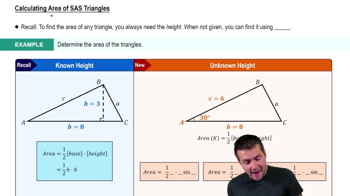
Calculating Area of SAS Triangles

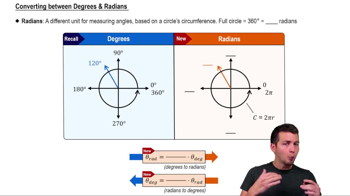
Radian Measure of Angles

Radians measure angles based on the radius of a circle, where one radian is the angle subtended by an arc equal in length to the radius. Using radians simplifies many trigonometric formulas, especially those involving arc length and sector area.
Recommended video:
5:04
Converting between Degrees & Radians

Solving for the Central Angle

To find the central angle θ when the sector area and radius are known, rearrange the sector area formula to θ = (2 * A) / r². This step involves algebraic manipulation and understanding the relationship between the variables.
Recommended video:
2:28
Solving Problems with Complementary & Supplementary Angles