Ch. 3 - Radian Measure and The Unit Circle
Lial - Trigonometry 12th Edition
Lial12th EditionTrigonometryISBN: 9780136552161Not the one you use?Change textbook
Chapter 4, Problem 85

For each value of s, use a calculator to find sin s and cos s, and then use the results to decide in which quadrant an angle of s radians lies.
s = 65

Verified step by step guidance
1
Understand that the angle given, \(s = 65\) radians, is quite large since one full rotation (circle) is \(2\pi\) radians, approximately \(6.283\) radians. To find the equivalent angle within one full rotation, reduce \(s\) by subtracting multiples of \(2\pi\) until the result lies between \(0\) and \(2\pi\) radians.
Calculate the equivalent angle \(s_{\text{equiv}}\) using the formula: \(s_{\text{equiv}} = s - 2\pi \times n\), where \(n\) is the largest integer such that \(s_{\text{equiv}}\) is between \(0\) and \(2\pi\). This step helps to find the coterminal angle within the first rotation.
Use a calculator to find \(\sin(s_{\text{equiv}})\) and \(\cos(s_{\text{equiv}})\). These values will help determine the quadrant of the angle because the signs of sine and cosine vary by quadrant.
Recall the sign rules for sine and cosine in each quadrant: - Quadrant I: \(\sin > 0\), \(\cos > 0\) - Quadrant II: \(\sin > 0\), \(\cos < 0\) - Quadrant III: \(\sin < 0\), \(\cos < 0\) - Quadrant IV: \(\sin < 0\), \(\cos > 0\)
Based on the signs of \(\sin(s_{\text{equiv}})\) and \(\cos(s_{\text{equiv}})\), identify the quadrant in which the angle \(s\) lies.

Verified video answer for a similar problem:

This video solution was recommended by our tutors as helpful for the problem above.
Was this helpful?

Key Concepts

Here are the essential concepts you must grasp in order to answer the question correctly.

Unit Circle and Angle Measurement in Radians

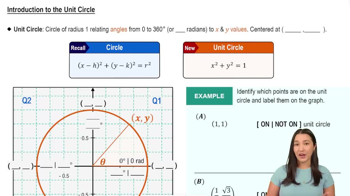
The unit circle is a circle with radius 1 centered at the origin, used to define sine and cosine for all angles. Angles measured in radians correspond to arc lengths on this circle, where 2π radians equal 360 degrees. Understanding how angles wrap around the circle helps determine their position in different quadrants.
Recommended video:
06:11
Introduction to the Unit Circle

Sine and Cosine Values and Their Signs

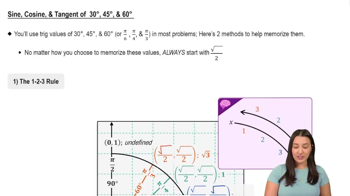
Sine and cosine functions give the y- and x-coordinates of a point on the unit circle for a given angle. The sign (positive or negative) of sin and cos values indicates the quadrant: for example, sin is positive in quadrants I and II, while cos is positive in quadrants I and IV.
Recommended video:
5:08
Sine, Cosine, & Tangent of 30°, 45°, & 60°

Quadrant Determination Using Trigonometric Signs

Each quadrant of the coordinate plane has a unique combination of signs for sine and cosine. By calculating sin s and cos s, and noting their signs, one can identify the quadrant where the angle s lies: Quadrant I (+, +), II (+, -), III (-, -), or IV (-, +).
Recommended video:
6:36
Quadratic Formula