Ch. 3 - Radian Measure and The Unit Circle
Lial - Trigonometry 12th Edition
Lial12th EditionTrigonometryISBN: 9780136552161Not the one you use?Change textbook
Chapter 4, Problem 3.41

Find the linear speed v for each of the following.


a point on the edge of a flywheel of radius 2 m, rotating 42 times per min

Verified step by step guidance
1
Identify the given values: the radius of the flywheel \(r = 2\) meters, and the rotational speed \(f = 42\) revolutions per minute (rpm).
Recall the formula for linear speed \(v\) of a point on the edge of a rotating object: \(v = r \times \omega\), where \(\omega\) is the angular velocity in radians per unit time.
Convert the rotational speed from revolutions per minute to angular velocity in radians per second using the conversion: \(\omega = 2\pi \times \frac{f}{60}\), because one revolution equals \(2\pi\) radians and there are 60 seconds in a minute.
Substitute the values into the angular velocity formula: \(\omega = 2\pi \times \frac{42}{60}\) radians per second.
Finally, calculate the linear speed by multiplying the radius by the angular velocity: \(v = 2 \times \omega\). This will give the linear speed in meters per second.

Verified video answer for a similar problem:

This video solution was recommended by our tutors as helpful for the problem above.
Was this helpful?

Key Concepts

Here are the essential concepts you must grasp in order to answer the question correctly.

Angular Velocity

Angular velocity measures how fast an object rotates, typically expressed in radians per second. It relates the number of rotations per unit time to the angle covered, where one full rotation equals 2π radians. Converting rotations per minute (rpm) to radians per second is essential for calculations involving rotational motion.
Recommended video:
03:48
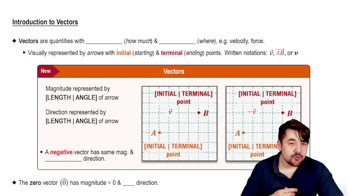
Introduction to Vectors

Linear Speed in Circular Motion

Linear speed (v) of a point on a rotating object is the distance traveled per unit time along the circular path. It is related to angular velocity (ω) by the formula v = ωr, where r is the radius. This relationship connects rotational motion to linear motion at the edge of the rotating body.
Recommended video:
6:00
Categorizing Linear Equations

Unit Conversion and Application

Accurate unit conversion is crucial, especially converting rpm to radians per second and ensuring radius units are consistent. Applying the correct formula with proper units allows for precise calculation of linear speed, which is vital in practical problems involving rotating objects like flywheels.
Recommended video:
06:11
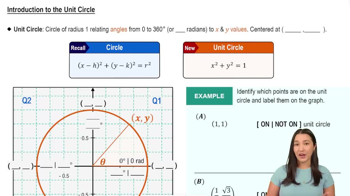
Introduction to the Unit Circle