Ch. 3 - Radian Measure and The Unit Circle
Lial - Trigonometry 12th Edition
Lial12th EditionTrigonometryISBN: 9780136552161Not the one you use?Change textbook
Chapter 4, Problem 52

Convert each degree measure to radians. If applicable, round to the nearest thousandth. See Example 1(c).


85.04°

Verified step by step guidance
1
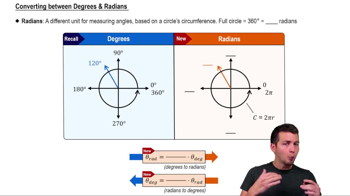
Recall the formula to convert degrees to radians: \(\text{radians} = \text{degrees} \times \frac{\pi}{180}\).
Substitute the given degree measure into the formula: \(85.04^\circ \times \frac{\pi}{180}\).
Multiply the degree value by \(\pi\) to get \(85.04 \times \pi\) in the numerator.
Divide the result by 180 to complete the conversion to radians.
If needed, use a calculator to approximate the value and round the result to the nearest thousandth.

Verified video answer for a similar problem:

This video solution was recommended by our tutors as helpful for the problem above.
Was this helpful?

Key Concepts

Here are the essential concepts you must grasp in order to answer the question correctly.

Degree to Radian Conversion

Degrees and radians are two units for measuring angles. To convert degrees to radians, multiply the degree measure by π/180. This conversion is essential because radians are the standard unit in many mathematical contexts, especially calculus and trigonometry.
Recommended video:
5:04
Converting between Degrees & Radians

Use of π in Radian Measures

Radians are often expressed in terms of π because the circumference of a circle is 2π times its radius. This relationship makes π a natural constant in angle measurement, linking linear and angular dimensions. Understanding this helps interpret radian values both symbolically and numerically.
Recommended video:
5:04
Converting between Degrees & Radians

Rounding to the Nearest Thousandth

After converting degrees to radians, the result may be an irrational number. Rounding to the nearest thousandth means limiting the decimal places to three digits, which balances precision and simplicity. This is important for practical applications where exact values are unnecessary or unavailable.
Recommended video:
4:45
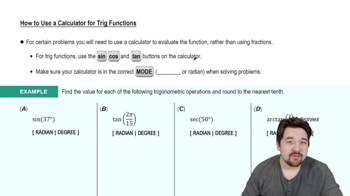
How to Use a Calculator for Trig Functions