Ch. 3 - Radian Measure and The Unit Circle
Lial - Trigonometry 12th Edition
Lial12th EditionTrigonometryISBN: 9780136552161Not the one you use?Change textbook
Chapter 4, Problem 6

CONCEPT PREVIEW Find the measure of each central angle (in radians).

Verified step by step guidance
1
Understand that a central angle in a circle is the angle formed at the center of the circle by two radii.
Recall that the total measure of all central angles around a point (the center of the circle) is \(2\pi\) radians.
If the problem involves dividing the circle into equal parts, determine how many parts the circle is divided into.
Use the formula for each central angle when the circle is divided into \(n\) equal parts: \(\text{Central angle} = \frac{2\pi}{n}\) radians.
Substitute the given number of parts into the formula to express the measure of each central angle in radians.

Verified video answer for a similar problem:

This video solution was recommended by our tutors as helpful for the problem above.
Was this helpful?

Key Concepts

Here are the essential concepts you must grasp in order to answer the question correctly.

Central Angle

A central angle is an angle whose vertex is at the center of a circle and whose sides intersect the circle, forming an arc. The measure of a central angle corresponds directly to the length of the arc it intercepts, making it fundamental in relating angles to arc lengths.
Recommended video:
04:46
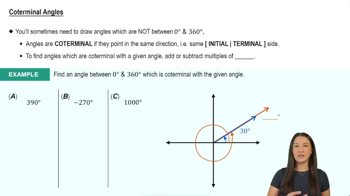
Coterminal Angles

Radian Measure

Radians are a unit of angular measure based on the radius of a circle. One radian is the angle subtended at the center of a circle by an arc equal in length to the radius. This unit simplifies calculations involving circles and is essential for expressing central angles in radians.
Recommended video:
5:04
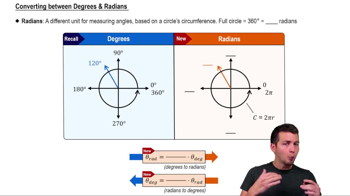
Converting between Degrees & Radians

Arc Length and Angle Relationship

The measure of a central angle in radians is equal to the length of the intercepted arc divided by the radius of the circle (θ = s/r). Understanding this relationship allows for converting between arc length and angle measure, which is key to solving problems involving central angles.
Recommended video:
4:18
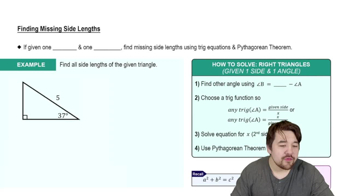
Finding Missing Side Lengths