Ch. 3 - Radian Measure and The Unit Circle
Lial - Trigonometry 12th Edition
Lial12th EditionTrigonometryISBN: 9780136552161Not the one you use?Change textbook
Chapter 4, Problem 3.53

Find the approximate value of s, to four decimal places, in the interval [0, π/2] that makes each statement true.
sin s = 0.4924

Verified step by step guidance
1
Start by understanding that you need to find the angle \( s \) such that \( \sin s = 0.4924 \).
Since \( s \) is in the interval \([0, \pi/2]\), you are looking for an angle in the first quadrant where the sine function is positive.
Use the inverse sine function, also known as arcsine, to find \( s \). This is written as \( s = \sin^{-1}(0.4924) \).
Use a calculator to find the approximate value of \( s \) in radians, ensuring your calculator is set to the correct mode (radians).
Round the result to four decimal places to get the final approximate value of \( s \).

Verified video answer for a similar problem:

This video solution was recommended by our tutors as helpful for the problem above.
Was this helpful?

Key Concepts

Here are the essential concepts you must grasp in order to answer the question correctly.

Sine Function

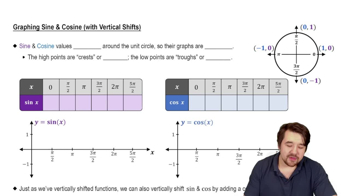
The sine function, denoted as sin, is a fundamental trigonometric function that relates the angle of a right triangle to the ratio of the length of the opposite side to the hypotenuse. It is periodic and oscillates between -1 and 1. In the context of the unit circle, sin(s) represents the y-coordinate of a point on the circle corresponding to the angle s.
Recommended video:
5:53
Graph of Sine and Cosine Function

Inverse Sine Function

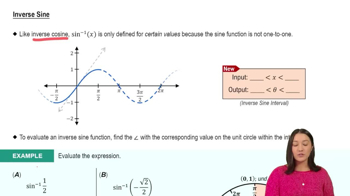
The inverse sine function, or arcsin, is used to determine the angle whose sine is a given value. It is denoted as sin⁻¹ or arcsin and is defined for values in the range [-1, 1]. The output of arcsin is restricted to the interval [-π/2, π/2], but when considering the sine function's periodicity, we can find multiple angles that yield the same sine value.
Recommended video:
4:03
Inverse Sine

Interval [0, π/2]

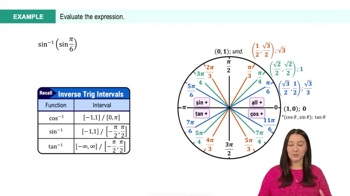
The interval [0, π/2] represents the first quadrant of the unit circle, where both sine and cosine functions are positive. In this interval, the sine function is increasing, meaning that as the angle s increases from 0 to π/2, the value of sin(s) also increases from 0 to 1. This property is crucial for finding the angle s that satisfies the equation sin(s) = 0.4924 within the specified range.
Recommended video:
1:48
Example 2