Ch. 3 - Radian Measure and The Unit Circle
Lial - Trigonometry 12th Edition
Lial12th EditionTrigonometryISBN: 9780136552161Not the one you use?Change textbook
Chapter 4, Problem 65

Find the approximate value of s, to four decimal places, in the interval [0 , π/2] that makes each statement true.


sec s = 1.0806

Verified step by step guidance
1
Recall the definition of the secant function: \(\sec s = \frac{1}{\cos s}\). This means that \(\cos s = \frac{1}{\sec s}\).
Substitute the given value of \(\sec s\) into the equation: \(\cos s = \frac{1}{1.0806}\).
Calculate the value of \(\cos s\) from the above expression (you can do this with a calculator, but do not finalize the answer here).
Use the inverse cosine function to find \(s\): \(s = \arccos(\cos s)\), where \(s\) is in the interval \([0, \frac{\pi}{2}]\).
Express the value of \(s\) in radians and round it to four decimal places as required.

Verified video answer for a similar problem:

This video solution was recommended by our tutors as helpful for the problem above.
Was this helpful?

Key Concepts

Here are the essential concepts you must grasp in order to answer the question correctly.

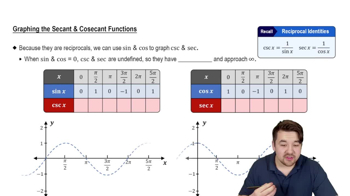
Definition of Secant Function

The secant function, sec(θ), is the reciprocal of the cosine function, defined as sec(θ) = 1/cos(θ). Understanding this relationship allows you to convert the given secant value into a cosine value, which is often easier to work with when solving for the angle.
Recommended video:
6:22
Graphs of Secant and Cosecant Functions

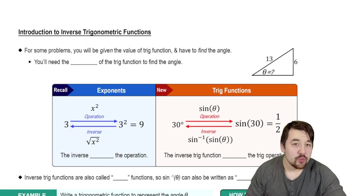
Inverse Trigonometric Functions

Inverse trigonometric functions, such as arccos, are used to find the angle corresponding to a given trigonometric value. After finding cos(s) from sec(s), applying arccos helps determine the angle s within the specified interval [0, π/2].
Recommended video:
4:28
Introduction to Inverse Trig Functions

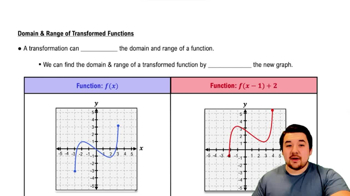
Domain and Range Restrictions

The problem restricts s to the interval [0, π/2], which corresponds to the first quadrant where cosine values are positive. This restriction ensures the solution is unique and helps in selecting the correct angle from the inverse cosine function.
Recommended video:
4:22
Domain and Range of Function Transformations