Ch. 3 - Radian Measure and The Unit Circle
Lial - Trigonometry 12th Edition
Lial12th EditionTrigonometryISBN: 9780136552161Not the one you use?Change textbook
Chapter 4, Problem 3.55

Find the approximate value of s, to four decimal places, in the interval [0, π/2] that makes each statement true.
cot s = 0.5022

Verified step by step guidance
1
Recognize that \( \cot(s) = \frac{1}{\tan(s)} \). Therefore, \( \tan(s) = \frac{1}{0.5022} \).
Calculate \( \tan(s) \) using the reciprocal of 0.5022.
Use a calculator to find the angle \( s \) in radians for which \( \tan(s) \) equals the calculated value.
Ensure that the angle \( s \) is within the interval \([0, \frac{\pi}{2}]\).
Round the value of \( s \) to four decimal places.

Verified video answer for a similar problem:

This video solution was recommended by our tutors as helpful for the problem above.
Was this helpful?

Key Concepts

Here are the essential concepts you must grasp in order to answer the question correctly.

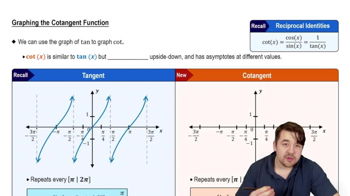
Cotangent Function

The cotangent function, denoted as cot(s), is the reciprocal of the tangent function. It is defined as cot(s) = cos(s)/sin(s). In the context of the unit circle, cotangent represents the ratio of the adjacent side to the opposite side in a right triangle. Understanding cotangent is essential for solving equations involving angles and their trigonometric ratios.
Recommended video:
5:37
Introduction to Cotangent Graph

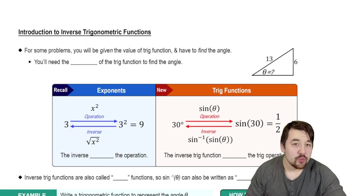
Inverse Trigonometric Functions

Inverse trigonometric functions, such as arccot or cot^(-1), are used to find the angle that corresponds to a given trigonometric ratio. For example, if cot(s) = 0.5022, we can use the inverse cotangent function to determine the angle s. These functions are crucial for solving equations where the angle is unknown and must be derived from a known ratio.
Recommended video:
4:28
Introduction to Inverse Trig Functions

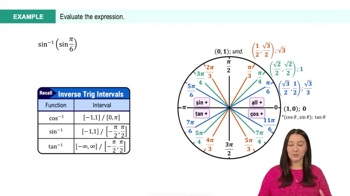
Interval [0, π/2]

The interval [0, π/2] represents the range of angles from 0 to 90 degrees, where all trigonometric functions are positive. This interval is significant when solving trigonometric equations because it restricts the possible values of s, ensuring that the solution is within the first quadrant. Understanding the implications of this interval helps in determining the correct angle that satisfies the given cotangent value.
Recommended video:
1:48
Example 2