Ch. 2 - Acute Angles and Right Triangles
Lial - Trigonometry 12th Edition
Lial12th EditionTrigonometryISBN: 9780136552161Not the one you use?Change textbook
Chapter 3, Problem 2.3.16

Use a calculator to approximate the value of each expression. Give answers to six decimal places. In Exercises 21–28, simplify the expression before using the calculator. See Example 1.
tan 421° 30'

Verified step by step guidance
1
Convert the angle from degrees and minutes to a decimal degree format. Since 1 minute is \( \frac{1}{60} \) of a degree, calculate the decimal degrees as \( 421 + \frac{30}{60} \).
Simplify the angle by reducing it within the standard range of \(0^\circ\) to \(360^\circ\) using the formula \( \theta_{reduced} = \theta - 360k \), where \(k\) is an integer chosen so that \( \theta_{reduced} \) lies in the desired range.
Use the tangent function on the simplified angle: \( \tan(\theta_{reduced}) \).
Use a calculator to find the approximate value of \( \tan(\theta_{reduced}) \), making sure the calculator is set to degree mode.
Round the result to six decimal places as requested.

Verified video answer for a similar problem:

This video solution was recommended by our tutors as helpful for the problem above.
Video duration:
2m
Was this helpful?

Key Concepts

Here are the essential concepts you must grasp in order to answer the question correctly.

Angle Conversion Between Degrees and Minutes

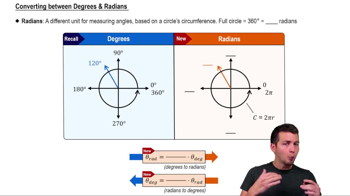
Angles given in degrees and minutes must be converted into decimal degrees before calculation. Since 1 minute equals 1/60 of a degree, 30' is converted to 0.5°, making 421° 30' equal to 421.5°. This conversion is essential for accurate input into calculators.
Recommended video:
5:04
Converting between Degrees & Radians

Coterminal Angles and Angle Reduction

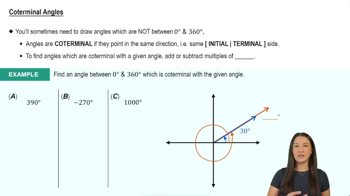
Angles larger than 360° can be reduced by subtracting multiples of 360° to find a coterminal angle within the standard 0° to 360° range. This simplification helps in evaluating trigonometric functions more easily and avoids calculator errors.
Recommended video:
04:46
Coterminal Angles

Using a Calculator to Find Trigonometric Values

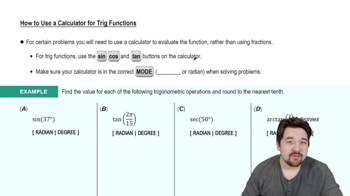
After simplifying the angle, use a scientific calculator set to degree mode to find the tangent value. Ensure the calculator is in the correct mode and round the result to six decimal places as required for precision.
Recommended video:
4:45
How to Use a Calculator for Trig Functions
Related Practice
Textbook Question

(Modeling) Grade Resistance Solve each problem. See Example 3. A 3000-lb car traveling uphill has a grade resistance of 150 lb. Find the angle of the grade to the nearest tenth of a degree.

7
views

Textbook Question

Use a calculator to determine whether each statement is true or false. A true statement may lead to results that differ in the last decimal place due to rounding error. sin 10° + sin 10° = sin 20°

2
views
Textbook Question

Find exact values of the six trigonometric functions for each angle A.

1
views
Textbook Question

CONCEPT PREVIEW Match the measure of bearing in Column I with the appropriate graph in Column II.

I. 8. 270°


II.

1. A. B. C. 2. 3. 4. D. E. F. 5. 6. 7. G. H. 9. 10. I. J.

1
views
1
rank
Textbook Question

(Modeling) Length of a Sag Curve When a highway goes downhill and then uphill, it has a sag curve. Sag curves are designed so that at night, headlights shine sufficiently far down the road to allow a safe stopping distance. See the figure. S and L are in feet. The minimum length L of a sag curve is determined by the height h of the car's headlights above the pavement, the downhill grade θ₁ < 0°, the uphill grade θ₂ > 0°, and the safe stopping distance S for a given speed limit. In addition, L is dependent on the vertical alignment of the headlights. Headlights are usually pointed upward at a slight angle α above the horizontal of the car. Using these quantities, for a 55 mph speed limit, L can be modeled by the formula (θ₂ - θ₁)S² L = ————————— , 200(h + S tan α) where S < L. (Data from Mannering, F., and W. Kilareski, Principles of Highway Engineering and Traffic Analysis, Second Edition, John Wiley and Sons.) Compute length L, to the nearest foot, if h = 1.9 ft, α = 0.9°, θ₁ = -3°, θ₂ = 4°, and S = 336 ft.

1
views
Textbook Question

Use a calculator to approximate the value of each expression. Give answers to six decimal places. In Exercises 21–28, simplify the expression before using the calculator. See Example 1. csc 145° 45'

1
views