
Ch. 2 - Acute Angles and Right Triangles
Lial - Trigonometry 12th Edition
Lial12th EditionTrigonometryISBN: 9780136552161Not the one you use?Change textbook
Chapter 3, Problem 2.3.26

Use a calculator to approximate the value of each expression. Give answers to six decimal places. In Exercises 21–28, simplify the expression before using the calculator. See Example 1.
cos(90°-3.69°)

Verified step by step guidance
1
Recognize that the expression involves the cosine of a difference: \(\cos(90^\circ - 3.69^\circ)\).
Recall the co-function identity in trigonometry: \(\cos(90^\circ - \theta) = \sin(\theta)\).
Apply this identity to rewrite the expression as \(\sin(3.69^\circ)\).
Use a calculator to find the sine of \(3.69^\circ\). Make sure your calculator is set to degree mode.
Round the result to six decimal places as requested.

Verified video answer for a similar problem:

This video solution was recommended by our tutors as helpful for the problem above.
Video duration:
2m
Was this helpful?

Key Concepts

Here are the essential concepts you must grasp in order to answer the question correctly.

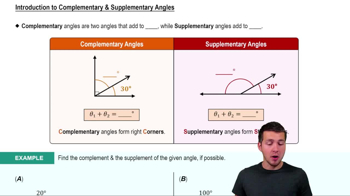
Complementary Angle Identity

The complementary angle identity states that cos(90° - θ) = sin(θ). This relationship allows simplification of trigonometric expressions by converting cosine of a complementary angle into sine, which can be easier to evaluate or interpret.
Recommended video:
3:35
Intro to Complementary & Supplementary Angles

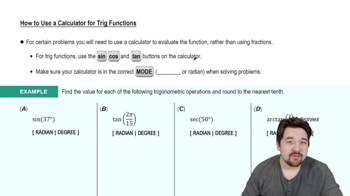
Using a Calculator for Trigonometric Values

Calculators can compute trigonometric functions like sine and cosine, but the angle mode (degrees or radians) must be set correctly. For angles given in degrees, ensure the calculator is in degree mode to get accurate results.
Recommended video:
4:45
How to Use a Calculator for Trig Functions

Rounding and Decimal Precision

When approximating values, it is important to round the result to the specified number of decimal places. Here, answers should be rounded to six decimal places to maintain consistency and precision in reporting the value.
Recommended video:
2:22
Cardioids Example 1