Ch. 2 - Acute Angles and Right Triangles
Lial - Trigonometry 12th Edition
Lial12th EditionTrigonometryISBN: 9780136552161Not the one you use?Change textbook
Chapter 3, Problem 16

Suppose ABC is a right triangle with sides of lengths a, b, and c and right angle at C. Use the Pythagorean theorem to find the unknown side length. Then find exact values of the six trigonometric functions for angle B. Rationalize denominators when applicable. See Example 1. b = 8, c = 11

Verified step by step guidance
1
Identify the sides of the right triangle ABC, where the right angle is at C. This means sides a and b are the legs, and side c is the hypotenuse opposite the right angle.
Use the Pythagorean theorem, which states \(a^2 + b^2 = c^2\), to find the unknown side length \(a\). Substitute the known values \(b = 8\) and \(c = 11\) into the equation: \(a^2 + 8^2 = 11^2\).
Solve for \(a^2\) by calculating \(a^2 = 11^2 - 8^2\). Then take the positive square root to find \(a\), since side lengths are positive.
Once you have \(a\), find the six trigonometric functions for angle \(B\). Recall that angle \(B\) is adjacent to side \(b\) and opposite side \(a\), with hypotenuse \(c\). The functions are:
- \(\sin B = \frac{\text{opposite}}{\text{hypotenuse}} = \frac{a}{c}\)
- \(\cos B = \frac{\text{adjacent}}{\text{hypotenuse}} = \frac{b}{c}\)
- \(\tan B = \frac{\text{opposite}}{\text{adjacent}} = \frac{a}{b}\)
- \(\csc B = \frac{1}{\sin B} = \frac{c}{a}\)
- \(\sec B = \frac{1}{\cos B} = \frac{c}{b}\)
- \(\cot B = \frac{1}{\tan B} = \frac{b}{a}\)
Express each function in simplest exact form and rationalize denominators where necessary.

Verified video answer for a similar problem:

This video solution was recommended by our tutors as helpful for the problem above.
Video duration:
6m
Was this helpful?

Key Concepts

Here are the essential concepts you must grasp in order to answer the question correctly.

Pythagorean Theorem

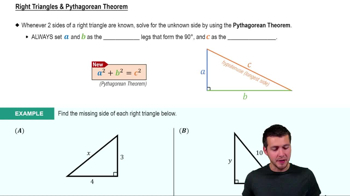
The Pythagorean theorem states that in a right triangle, the square of the hypotenuse (side opposite the right angle) equals the sum of the squares of the other two sides. It is expressed as a² + b² = c². This theorem allows you to find an unknown side length when the other two are known.
Recommended video:
5:19
Solving Right Triangles with the Pythagorean Theorem

Trigonometric Functions

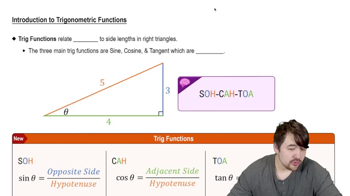
The six trigonometric functions—sine, cosine, tangent, cosecant, secant, and cotangent—relate the angles of a right triangle to the ratios of its sides. For an angle, these functions are defined as ratios of the opposite, adjacent, and hypotenuse sides, providing exact values for angle measures.
Recommended video:
6:04
Introduction to Trigonometric Functions

Rationalizing Denominators

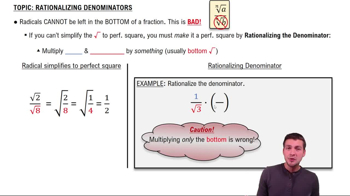
Rationalizing denominators involves eliminating any square roots or irrational numbers from the denominator of a fraction. This is done by multiplying numerator and denominator by a suitable radical, making expressions simpler and more standardized in trigonometric calculations.
Recommended video:
2:58
Rationalizing Denominators