Find exact values of the six trigonometric functions of each angle. Rationalize denominators when applicable. See Examples 2, 3, and 5. 300°
Ch. 2 - Acute Angles and Right Triangles
Chapter 3, Problem 19
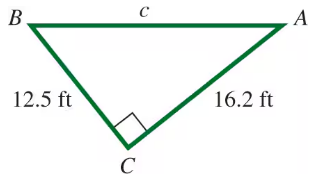
Solve each right triangle. When two sides are given, give angles in degrees and minutes.

Verified step by step guidance1
Identify the two given sides of the right triangle. Label the sides as opposite (O), adjacent (A), or hypotenuse (H) relative to the angle you want to find.
Use the Pythagorean theorem \(H^2 = O^2 + A^2\) to find the missing side if it is not given. Rearrange the formula to solve for the unknown side.
Choose the appropriate trigonometric ratio to find the unknown angle: sine \(\sin \theta = \frac{O}{H}\), cosine \(\cos \theta = \frac{A}{H}\), or tangent \(\tan \theta = \frac{O}{A}\), depending on the sides you know.
Calculate the angle \(\theta\) by taking the inverse trigonometric function: \(\theta = \sin^{-1}(\frac{O}{H})\), \(\theta = \cos^{-1}(\frac{A}{H})\), or \(\theta = \tan^{-1}(\frac{O}{A})\).
Convert the decimal degree result into degrees and minutes by separating the integer part as degrees and multiplying the decimal part by 60 to get minutes.

Verified video answer for a similar problem:
This video solution was recommended by our tutors as helpful for the problem above.
Was this helpful?
Key Concepts
Here are the essential concepts you must grasp in order to answer the question correctly.
Pythagorean Theorem
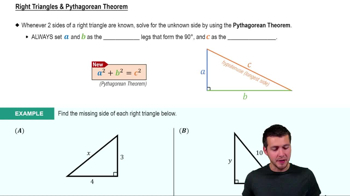
The Pythagorean theorem relates the lengths of the sides in a right triangle: the square of the hypotenuse equals the sum of the squares of the other two sides. It is essential for finding the missing side when two sides are known.
Recommended video:
Solving Right Triangles with the Pythagorean Theorem
Trigonometric Ratios (Sine, Cosine, Tangent)
Sine, cosine, and tangent ratios relate the angles of a right triangle to the ratios of its sides. These ratios allow calculation of unknown angles or sides when two sides are given, using inverse trigonometric functions to find angles.
Recommended video:
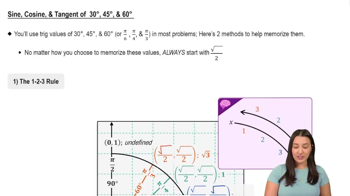
Sine, Cosine, & Tangent of 30°, 45°, & 60°
Conversion of Decimal Degrees to Degrees and Minutes
Angles are often expressed in degrees and minutes, where one degree equals 60 minutes. After calculating an angle in decimal degrees, converting the fractional part into minutes provides a more precise and conventional angle measurement.
Recommended video:
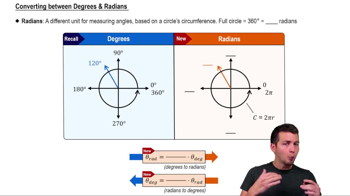
Converting between Degrees & Radians
Related Practice
Textbook Question
2
views
Textbook Question
Evaluate each expression. Give exact values. tan² 120° - 2 cot 240°
7
views
Textbook Question
Write each function in terms of its cofunction. Assume all angles involved are acute angles. See Example 2. sin 45°
Textbook Question
Find exact values of the six trigonometric functions of each angle. Rationalize denominators when applicable. See Examples 2, 3, and 5. 405°
2
views
Textbook Question
Find all values of θ, if θ is in the interval [0°, 360°) and has the given function value. sec θ = -2√3 3
3
views
Textbook Question
Suppose ABC is a right triangle with sides of lengths a, b, and c and right angle at C. Use the Pythagorean theorem to find the unknown side length. Then find exact values of the six trigonometric functions for angle B. Rationalize denominators when applicable. See Example 1. a = √2, c = 2
5
views