Ch. 2 - Acute Angles and Right Triangles
Lial - Trigonometry 12th Edition
Lial12th EditionTrigonometryISBN: 9780136552161Not the one you use?Change textbook
Chapter 3, Problem 2.5.30

Solve each problem. See Examples 1 and 2. Distance between Two Cities The bearing from Atlanta to Macon is S 27° E, and the bearing from Macon to Augusta is N 63° E. An automobile traveling at 62 mph needs 1¼ hr to go from Atlanta to Macon and 1¾ hr to go from Macon to Augusta. Find the distance from Atlanta to Augusta.

Verified step by step guidance
1
Identify the distances traveled from Atlanta to Macon and from Macon to Augusta using the formula \(\text{distance} = \text{speed} \times \text{time}\). For Atlanta to Macon, calculate \(d_1 = 62 \times 1.25\), and for Macon to Augusta, calculate \(d_2 = 62 \times 1.75\).
Draw a diagram representing the positions of Atlanta, Macon, and Augusta, including the bearings. The bearing from Atlanta to Macon is \(S 27^\circ E\), which means starting from south, rotate 27 degrees towards east. The bearing from Macon to Augusta is \(N 63^\circ E\), starting from north, rotate 63 degrees towards east.
Determine the angle between the two paths (Atlanta to Macon and Macon to Augusta) at point Macon. Since the bearings are given relative to the cardinal directions, find the interior angle between the two directions by adding or subtracting the given angles appropriately.
Use the Law of Cosines to find the distance from Atlanta to Augusta. Label the triangle with sides \(d_1\), \(d_2\), and the unknown side \(d\), and the included angle \(\theta\) found in the previous step. The Law of Cosines formula is: \(d^2 = d_1^2 + d_2^2 - 2 d_1 d_2 \cos(\theta)\).
Solve for \(d\) by taking the square root of both sides: \(d = \sqrt{d_1^2 + d_2^2 - 2 d_1 d_2 \cos(\theta)}\). This will give the distance from Atlanta to Augusta.

Verified video answer for a similar problem:

This video solution was recommended by our tutors as helpful for the problem above.
Video duration:
3m
Was this helpful?

Key Concepts

Here are the essential concepts you must grasp in order to answer the question correctly.

Bearing and Direction in Navigation

Bearing is a way to describe direction using angles relative to the cardinal points (N, S, E, W). For example, S 27° E means starting from south and rotating 27° towards east. Understanding how to interpret and convert these bearings into angles for calculations is essential for solving navigation problems.
Recommended video:
05:13
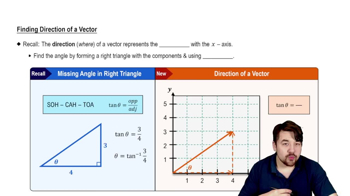
Finding Direction of a Vector

Distance, Speed, and Time Relationship

The relationship between distance, speed, and time is given by the formula distance = speed × time. Knowing the speed and travel time allows calculation of the distance between two points, which is crucial for determining the lengths of segments in the problem.
Recommended video:
4:56
Example 1

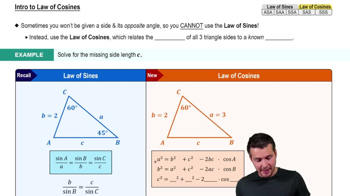
Law of Cosines for Non-Right Triangles

The Law of Cosines relates the lengths of sides of any triangle to the cosine of one of its angles. It is used to find an unknown side when two sides and the included angle are known, which is necessary here to find the distance between Atlanta and Augusta given the bearings and distances.
Recommended video:
4:35
Intro to Law of Cosines
Related Practice
Textbook Question

Find a value of θ in the interval [0°, 90°) that satisfies each statement. Give answers in decimal degrees to six decimal places. See Example 2. cot θ = 0.21563481

1
views

Textbook Question

Concept Check The two methods of expressing bearing can be interpreted using a rectangular coordinate system. Suppose that an observer for a radar station is located at the origin of a coordinate system. Find the bearing of an airplane located at each point. Express the bearing using both methods. (2, 2)

Textbook Question

(Modeling) Fish's View of the World The figure shows a fish's view of the world above the surface of the water. (Data from Walker, J., 'The Amateur Scientist,' Scientific American.) Suppose that a light ray comes from the horizon, enters the water, and strikes the fish's eye. Assume that this ray gives a value of 90° for angle θ₁ in the formula for Snell's law. (In a practical situation, this angle would probably be a little less than 90°.) The speed of light in water is about 2.254 x 10⁸ m per sec. Find angle θ₂ to the nearest tenth.

1
views
Textbook Question

(Modeling) Speed of Light When a light ray travels from one medium, such as air, to another medium, such as water or glass, the speed of the light changes, and the light ray is bent, or refracted, at the boundary between the two media. (This is why objects under water appear to be in a different position from where they really are.) It can be shown in physics that these changes are related by Snell's law c₁ = sin θ₁ , c₂ sin θ₂ where c₁ is the speed of light in the first medium, c₂ is the speed of light in the second medium, and θ₁ and θ₂ are the angles shown in the figure. In Exercises 81 and 82, assume that c₁ = 3 x 10⁸ m per sec. Find the speed of light in the second medium for each of the following. a. θ₁ = 46°, θ₂ = 31° b. θ₁ = 39°, θ₂ = 28°

1
views
Textbook Question

Solve each problem. See Examples 1 and 2. Distance between Two Ships Two ships leave a port at the same time. The first ship sails on a bearing of 52° at 17 knots and the second on a bearing of 322° at 22 knots. How far apart are they after 2.5 hr?

Textbook Question

Find a value of θ in the interval [0°, 90°) that satisfies each statement. Give answers in decimal degrees to six decimal places. See Example 2.

sin θ = 0.84802194

7
views