Evaluate each expression. See Example 4. cot² 135° - sin 30° + 4 tan 45°
Ch. 2 - Acute Angles and Right Triangles
Chapter 3, Problem 48
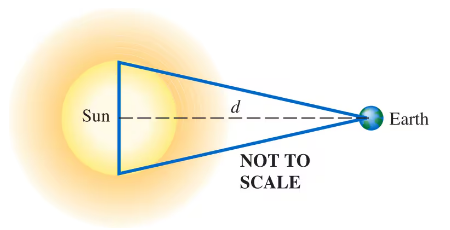
Solve each problem. See Examples 1–4. Diameter of the Sun To determine the diameter of the sun, an astronomer might sight with a transit (a device used by surveyors for measuring angles) first to one edge of the sun and then to the other, estimating that the included angle equals 32'. Assuming that the distance d from Earth to the sun is 92,919,800 mi, approximate the diameter of the sun.

Verified step by step guidance1
Understand the problem: The astronomer measures the angle subtended by the diameter of the sun from Earth, which is given as 32 minutes of arc (32'). The goal is to find the actual diameter of the sun using this angle and the distance from Earth to the sun.
Convert the angle from minutes to degrees because trigonometric functions typically use degrees or radians. Since 1 degree = 60 minutes, the angle in degrees is \(\theta = \frac{32}{60}\) degrees.
Recognize that the angle \(\theta\) is very small and subtended by the diameter of the sun at distance \(d\). We can model this situation as an isosceles triangle where the sun's diameter is the base opposite the angle \(\theta\) at the observer's point.
Use the small-angle approximation or the formula relating arc length to radius and angle in radians. First, convert the angle \(\theta\) to radians: \(\theta_{rad} = \theta \times \frac{\pi}{180}\). Then, the diameter \(D\) of the sun can be approximated by \(D = d \times \theta_{rad}\), where \(d\) is the distance to the sun.
Substitute the given distance \(d = 92,919,800\) miles and the angle in radians into the formula to find the diameter \(D\). This will give the approximate diameter of the sun.

Verified video answer for a similar problem:
This video solution was recommended by our tutors as helpful for the problem above.
Video duration:
7mWas this helpful?
Key Concepts
Here are the essential concepts you must grasp in order to answer the question correctly.
Angular Measurement in Degrees and Minutes
Angles can be measured in degrees, minutes, and seconds, where 1 degree equals 60 minutes. In this problem, the angle between the two edges of the sun is given as 32 minutes (32'), which must be converted to degrees or radians for calculations involving trigonometric functions or arc length.
Recommended video:
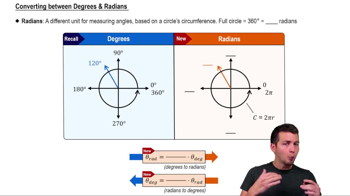
Converting between Degrees & Radians
Arc Length and Circle Geometry
The diameter of the sun can be approximated by treating the sun as an arc subtending a small angle at the observer's eye. Using the formula for arc length (arc length = radius × angle in radians), the diameter corresponds to the arc length formed by the angle measured from Earth, with the radius being the distance to the sun.
Recommended video:
Adding Vectors Geometrically
Angle Conversion to Radians
Trigonometric calculations involving arc length require the angle to be in radians. To convert from degrees or minutes to radians, use the conversion factor π radians = 180 degrees. This step is essential to accurately compute the sun's diameter from the given angular measurement.
Recommended video:
Converting between Degrees & Radians
Related Practice
Textbook Question
3
views
Textbook Question
Solve each right triangle. In Exercise 46, give angles to the nearest minute. In Exercises 47 and 48, label the triangle ABC as in Exercises 45 and 46. A = 39.72°, b = 38.97 m
Textbook Question
Give the exact value of each expression. See Example 5. tan 30°
Textbook Question
Solve each problem. See Examples 1–4. Distance across a Lake To find the distance RS across a lake, a surveyor lays off length RT = 53.1 m, so that angle T = 32°10' and angle S = 57°50'. Find length RS.
<Image>
1
views
Textbook Question
Determine whether each statement is true or false. See Example 4. csc 20° < csc 30°
Textbook Question
Solve each problem. See Examples 1–4. Altitude of a Triangle Find the altitude of an isosceles triangle having base 184.2 cm if the angle opposite the base is 68°44'.
5
views