Ch. 2 - Acute Angles and Right Triangles
Lial - Trigonometry 12th Edition
Lial12th EditionTrigonometryISBN: 9780136552161Not the one you use?Change textbook
Chapter 3, Problem 2.5.2

CONCEPT PREVIEW Match the measure of bearing in Column I with the appropriate graph in Column II.
I. S 70° W


II. 1. A. B. C. 2. S 70° W 3. 4. D. E. F. 5. 6. 7. G. H. 8. 9. 10. I. J.

Verified step by step guidance
1
Understand that a bearing is a way to describe direction using degrees measured clockwise from the north line. Bearings are typically given in the format: N or S followed by an angle and then E or W (e.g., S 70° W).
Interpret the bearing S 70° W: start facing due south (180°), then rotate 70° towards the west. This means the direction is 70° west of south.
Convert the bearing into a standard angle measured counterclockwise from the positive x-axis (east) if needed, or visualize it on a compass rose to match it with the correct graph.
Look at each graph in Column II and identify which one shows a vector or line pointing 70° west of south. This involves checking the orientation of the line relative to the cardinal directions shown.
Match the bearing S 70° W with the graph that correctly represents this direction, ensuring the angle and quadrant correspond to the bearing's description.

Verified video answer for a similar problem:

This video solution was recommended by our tutors as helpful for the problem above.
Video duration:
56s
Was this helpful?

Key Concepts

Here are the essential concepts you must grasp in order to answer the question correctly.

Understanding Bearings

Bearings are a way to describe direction using degrees measured clockwise from the north line. A bearing like S 70° W means starting from the south, rotate 70 degrees towards the west. This system helps in navigation and plotting directions on a map or graph.
Recommended video:
3:22
Example 2

Interpreting Compass Directions

Compass directions combine cardinal points (N, S, E, W) with angles to specify precise directions. For example, S 70° W indicates a direction 70 degrees west of due south. Understanding how to translate these into angles on a coordinate plane is essential for matching bearings to graphs.
Recommended video:
05:13
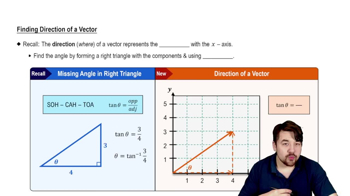
Finding Direction of a Vector

Graphical Representation of Directions

Graphs or diagrams often depict directions as vectors or lines from a reference point. Matching a bearing to a graph requires visualizing or drawing the angle relative to north or south, then identifying the correct graph that corresponds to the given bearing.
Recommended video:
04:19
Finding Direction of a Vector Example 1
Related Practice
Textbook Question

Use a calculator to approximate the value of each expression. Give answers to six decimal places. In Exercises 21–28, simplify the expression before using the calculator. See Example 1.

1/ sec 14.8°

8
views

Textbook Question

Solve each problem. See Examples 1 and 2. Distance Traveled by a Ship A ship travels 55 km on a bearing of 27° and then travels on a bearing of 117° for 140 km. Find the distance from the starting point to the ending point.

1
views
Textbook Question

Use a calculator to approximate the value of each expression. Give answers to six decimal places. In Exercises 21–28, simplify the expression before using the calculator. See Example 1. cot 183° 48'

1
views
Textbook Question

CONCEPT PREVIEW Match each trigonometric function value or angle in Column I with its appropriate approximation in Column II.


Column I: 1.

csc⁻¹ 4

Column II:

A. 88.09084757°

B. 63.25631605°

C. 1.909152433°

D. 17.45760312°

E. 0.2867453858

F. 1.962610506

G. 14.47751219°

H. 1.015426612

I. 1.051462224

J. 0.9925461516

1
views
Textbook Question

CONCEPT PREVIEW Match the measure of bearing in Column I with the appropriate graph in Column II.

I. 8. 270°


II.

1. A. B. C. 2. 3. 4. D. E. F. 5. 6. 7. G. H. 9. 10. I. J.

1
views
1
rank
Textbook Question

(Modeling) Length of a Sag Curve When a highway goes downhill and then uphill, it has a sag curve. Sag curves are designed so that at night, headlights shine sufficiently far down the road to allow a safe stopping distance. See the figure. S and L are in feet. The minimum length L of a sag curve is determined by the height h of the car's headlights above the pavement, the downhill grade θ₁ < 0°, the uphill grade θ₂ > 0°, and the safe stopping distance S for a given speed limit. In addition, L is dependent on the vertical alignment of the headlights. Headlights are usually pointed upward at a slight angle α above the horizontal of the car. Using these quantities, for a 55 mph speed limit, L can be modeled by the formula (θ₂ - θ₁)S² L = ————————— , 200(h + S tan α) where S < L. (Data from Mannering, F., and W. Kilareski, Principles of Highway Engineering and Traffic Analysis, Second Edition, John Wiley and Sons.) Compute length L, to the nearest foot, if h = 1.9 ft, α = 0.9°, θ₁ = -3°, θ₂ = 4°, and S = 336 ft.

1
views