Ch. 2 - Acute Angles and Right Triangles
Lial - Trigonometry 12th Edition
Lial12th EditionTrigonometryISBN: 9780136552161Not the one you use?Change textbook
Chapter 3, Problem 7

CONCEPT PREVIEW Match each trigonometric function value or angle in Column I with its appropriate approximation in Column II.
Column I: 1.
scs 80°
Column II:
A. 88.09084757°
B. 63.25631605°
C. 1.909152433°
D. 17.45760312°
E. 0.2867453858
F. 1.962610506
G. 14.47751219°
H. 1.015426612
I. 1.051462224
J. 0.9925461516

Verified step by step guidance
1
Step 1: Understand the problem requires matching trigonometric function values or angles from Column I with their approximate numerical values or angles in Column II.
Step 2: Recall the definitions of the trigonometric functions (sine, cosine, tangent, secant, cosecant, cotangent) and how to calculate their values for a given angle. For example, \( \sec \theta = \frac{1}{\cos \theta} \) and \( \csc \theta = \frac{1}{\sin \theta} \).
Step 3: Calculate or estimate the values of the trigonometric functions for the given angles in Column I, such as \( \csc 80^\circ \). Use a calculator or trigonometric tables to find \( \sin 80^\circ \) and then find its reciprocal to get \( \csc 80^\circ \).
Step 4: Compare the calculated values with the numerical approximations in Column II to find the closest match. For angles given in Column I, convert the trigonometric function values to degrees if necessary, or vice versa, to match the format in Column II.
Step 5: Repeat this process for each item in Column I, carefully matching each trigonometric value or angle with its corresponding approximation in Column II based on the calculations and conversions.

Verified video answer for a similar problem:

This video solution was recommended by our tutors as helpful for the problem above.
Video duration:
2m
Was this helpful?

Key Concepts

Here are the essential concepts you must grasp in order to answer the question correctly.

Trigonometric Functions and Their Values

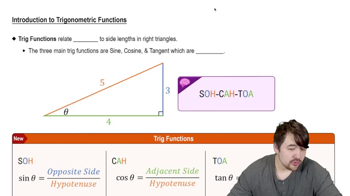
Trigonometric functions like sine, cosine, and secant relate angles to ratios of sides in right triangles. Understanding how to compute or approximate these values for given angles is essential for matching function values to their corresponding angles or numerical approximations.
Recommended video:
6:04
Introduction to Trigonometric Functions

Inverse Trigonometric Functions

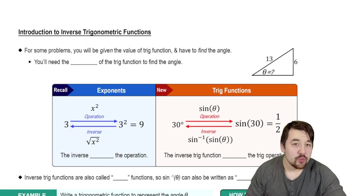
Inverse trig functions allow us to find an angle when given a trigonometric ratio. For example, if you know the value of secant, you can use the inverse secant function to determine the angle, which is crucial for matching numerical values to angle measures.
Recommended video:
4:28
Introduction to Inverse Trig Functions

Degree and Radian Measurement

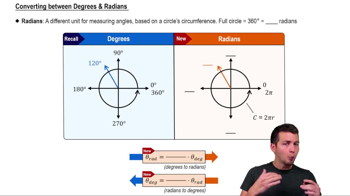
Angles can be measured in degrees or radians, and converting between these units is often necessary. Recognizing the unit of the given values and approximations helps in correctly matching angles with their trigonometric values.
Recommended video:
5:04
Converting between Degrees & Radians
Related Practice
Textbook Question

Concept Check Match each angle in Column I with its reference angle in Column II. Choices may be used once, more than once, or not at all. See Example 1. I. II. 5. A. 45° 6. B. 60° 7. -135° C. 82° 8. D. 30° 9. E. 38° 10. F. 32°

1
views
Textbook Question

Concept Check Refer to the discussion of accuracy and significant digits in this section to answer the following. Mt. Everest When Mt. Everest was first surveyed, the surveyors obtained a height of 29,000 ft to the nearest foot. State the range represented by this number. (The surveyors thought no one would believe a measurement of 29,000 ft, so they reported it as 29,002.) (Data from Dunham, W., The Mathematical Universe, John Wiley and Sons.)

Textbook Question

CONCEPT PREVIEW Match each trigonometric function value or angle in Column I with its appropriate approximation in Column II.

Column I: 1.

sec 18°

Column II:

A. 88.09084757°

B. 63.25631605°

C. 1.909152433°

D. 17.45760312°

E. 0.2867453858

F. 1.962610506

G. 14.47751219°

H. 1.015426612

I. 1.051462224

J. 0.9925461516

1
views
Textbook Question

Find exact values or expressions for sin A, cos A, and tan A. See Example 1.

1
views
Textbook Question

Determine whether each statement is true or false. If false, tell why. tan 60° ≥ cot 40°

Textbook Question

CONCEPT PREVIEW Match each trigonometric function value or angle in Column I with its appropriate approximation in Column II.

Column I: 1.

tan⁻¹ 30

Column II:

A. 88.09084757°

B. 63.25631605°

C. 1.909152433°

D. 17.45760312°

E. 0.2867453858

F. 1.962610506

G. 14.47751219°

H. 1.015426612

I. 1.051462224

J. 0.9925461516

2
views