Ch. 2 - Acute Angles and Right Triangles
Lial - Trigonometry 12th Edition
Lial12th EditionTrigonometryISBN: 9780136552161Not the one you use?Change textbook
Chapter 3, Problem 10

Concept Check Match each angle in Column I with its reference angle in Column II. Choices may be used once, more than once, or not at all. See Example 1. I. II. 5. A. 45° 6. B. 60° 7. C. 82° 8. D. 30° 9. E. 38° 10. 480° F. 32°

Verified step by step guidance
1
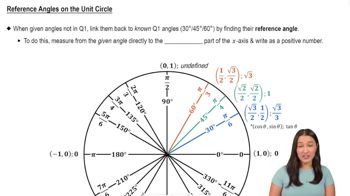
Understand that the reference angle of any given angle is the acute angle formed between the terminal side of the angle and the x-axis. It is always between 0° and 90°.
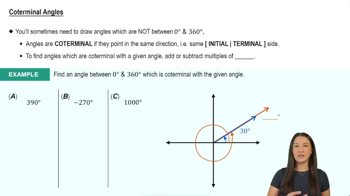
For angles greater than 360°, first find the equivalent angle between 0° and 360° by subtracting multiples of 360°. For example, for 480°, calculate \(480° - 360° = 120°\).
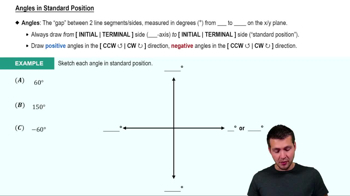
Determine the quadrant of the angle after reducing it to between 0° and 360°. For example, 120° lies in the second quadrant.
Use the quadrant to find the reference angle: - Quadrant I: reference angle = angle itself - Quadrant II: reference angle = \(180° - \text{angle}\) - Quadrant III: reference angle = \(\text{angle} - 180°\) - Quadrant IV: reference angle = \(360° - \text{angle}\)
Match each angle from Column I with the corresponding reference angle from Column II by applying the above steps to each angle.

Verified video answer for a similar problem:

This video solution was recommended by our tutors as helpful for the problem above.
Video duration:
1m
Was this helpful?

Key Concepts

Here are the essential concepts you must grasp in order to answer the question correctly.

Reference Angle

A reference angle is the acute angle formed between the terminal side of a given angle and the x-axis. It is always between 0° and 90°, and helps simplify trigonometric calculations by relating any angle to a corresponding acute angle.
Recommended video:
5:31
Reference Angles on the Unit Circle

Coterminal Angles

Coterminal angles differ by full rotations of 360°. For example, 480° is coterminal with 480° - 360° = 120°. Identifying coterminal angles helps reduce large angles to an equivalent angle within 0° to 360° for easier reference angle determination.
Recommended video:
04:46
Coterminal Angles

Quadrants and Angle Positioning

The quadrant in which an angle lies affects how its reference angle is calculated. Angles in Quadrant I have reference angles equal to themselves, while in other quadrants, the reference angle is found by subtracting the angle from 180°, 270°, or 360°, depending on the quadrant.
Recommended video:
05:50
Drawing Angles in Standard Position
Related Practice
Textbook Question

Determine whether each statement is true or false. If false, tell why. csc 22° ≤ csc 68°

4
views
Textbook Question

Concept Check Refer to the discussion of accuracy and significant digits in this section to answer the following. WNBA Scorer Women's National Basketball Association player Breanna Stewart of the Seattle Storm was the WNBA's top scorer for the 2018 regular season, with 742 points. Is it appropriate to consider this number between 741.5 and 742.5? Why or why not? (Data from www.wnba.com)

Textbook Question

Find exact values or expressions for sin A, cos A, and tan A. See Example 1.

1
views
Textbook Question

Concept Check Refer to the discussion of accuracy and significant digits in this section to answer the following. Mt. Everest When Mt. Everest was first surveyed, the surveyors obtained a height of 29,000 ft to the nearest foot. State the range represented by this number. (The surveyors thought no one would believe a measurement of 29,000 ft, so they reported it as 29,002.) (Data from Dunham, W., The Mathematical Universe, John Wiley and Sons.)

Textbook Question

Determine whether each statement is true or false. If false, tell why. tan 60° ≥ cot 40°

Textbook Question

Suppose ABC is a right triangle with sides of lengths a, b, and c and right angle at C. Use the Pythagorean theorem to find the unknown side length. Then find exact values of the six trigonometric functions for angle B. Rationalize denominators when applicable. See Example 1.

a = 5, b = 12