Find the measure of each marked angle. In Exercises 19–22, m and n are parallel. See Examples 1 and 2 .
Ch. 1 - Trigonometric Functions
Chapter 2, Problem 11
Find the measure of each marked angle.
Verified step by step guidance1
Identify the given angles and the relationships between them, such as complementary, supplementary, or vertical angles, based on the diagram or description provided.
Use the appropriate trigonometric or geometric relationships. For example, if two angles are complementary, their measures add up to \(180^\circ\), so you can write an equation like \(\angle A + \angle B = 180^\circ\).
Set up equations based on the relationships identified. For instance, if one angle is expressed in terms of another, write that expression clearly, such as \(\angle A = 2\angle B\).
Solve the equations algebraically to find the measure of each angle. This may involve substitution or combining like terms to isolate the variable representing the angle measure.
Verify your answers by checking that the sum of the angles satisfies the given relationships (e.g., sum to \(180^\circ\) for a straight line or \(90^\circ\) for complementary angles) to ensure consistency.

Verified video answer for a similar problem:
This video solution was recommended by our tutors as helpful for the problem above.
Video duration:
4mWas this helpful?
Key Concepts
Here are the essential concepts you must grasp in order to answer the question correctly.
Angle Measurement
Angle measurement quantifies the rotation between two intersecting lines or rays, typically expressed in degrees or radians. Understanding how to read and interpret angle measures is fundamental to solving problems involving marked angles.
Recommended video:
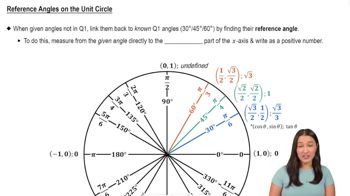
Reference Angles on the Unit Circle
Properties of Angles
Key properties such as complementary, supplementary, vertical, and adjacent angles help relate unknown angles to known ones. Recognizing these relationships allows for calculating missing angle measures using basic arithmetic.
Recommended video:
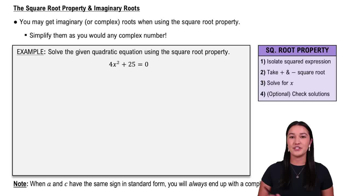
Imaginary Roots with the Square Root Property
Trigonometric Ratios
Trigonometric ratios (sine, cosine, tangent) relate the angles of a triangle to the lengths of its sides. These ratios are essential when angle measures are found indirectly through side lengths or when solving right triangles.
Recommended video:
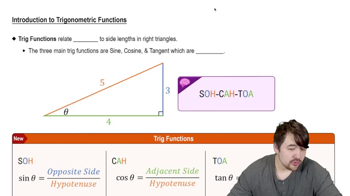
Introduction to Trigonometric Functions
Related Practice
Textbook Question
Textbook Question
Find the measure of each marked angle.
Textbook Question
Find the measure of (a) the complement and (b) the supplement of an angle with the given measure. See Examples 1 and 3. 30°
Textbook Question
Find the measure of each marked angle. In Exercises 19–22, m and n are parallel. See Examples 1 and 2 .
Textbook Question
Sketch an angle θ in standard position such that θ has the least positive measure, and the given point is on the terminal side of θ. Then find the values of the six trigonometric functions for each angle. Rationalize denominators when applicable. See Examples 1, 2, and 4. (―12 , ―5)
4
views
Textbook Question
CONCEPT PREVIEW The terminal side of an angle θ in standard position passes through the point (― 3,― I3) Use the figure to find the following values. Rationalize denominators when applicable. tan θ
2
views