Ch. 1 - Trigonometric Functions
Lial - Trigonometry 12th Edition
Lial12th EditionTrigonometryISBN: 9780136552161Not the one you use?Change textbook
Chapter 2, Problem 95

Concept Check Suppose that 90° < θ < 180° .   Find the sign of each function value. cos ( ―θ)

Verified step by step guidance
1
Recall the given range for \( \theta \): \( 90^\circ < \theta < 180^\circ \). This means \( \theta \) is in the second quadrant.
Understand that \( -\theta \) is the negative of \( \theta \). Since \( \theta \) is between 90° and 180°, \( -\theta \) will be between \( -180^\circ \) and \( -90^\circ \), which places \( -\theta \) in the third or fourth quadrant depending on the exact value.
Use the even-odd properties of cosine: cosine is an even function, so \( \cos(-\theta) = \cos(\theta) \). This means the sign of \( \cos(-\theta) \) is the same as the sign of \( \cos(\theta) \).
Determine the sign of \( \cos(\theta) \) in the second quadrant. Since cosine corresponds to the x-coordinate on the unit circle, and in the second quadrant x-values are negative, \( \cos(\theta) < 0 \).
Conclude that \( \cos(-\theta) \) is also negative because it equals \( \cos(\theta) \), which is negative in the second quadrant.

Verified video answer for a similar problem:

This video solution was recommended by our tutors as helpful for the problem above.
Video duration:
4m
Was this helpful?

Key Concepts

Here are the essential concepts you must grasp in order to answer the question correctly.

Quadrants and Angle Ranges

The coordinate plane is divided into four quadrants, each with specific angle ranges and sign conventions for trigonometric functions. For angles between 90° and 180°, the angle lies in the second quadrant, where sine is positive and cosine is negative. Understanding the quadrant helps determine the sign of trigonometric values.
Recommended video:
6:36
Quadratic Formula

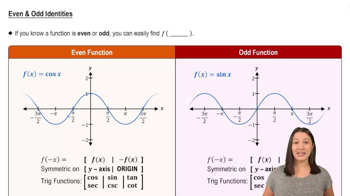
Even-Odd Identities in Trigonometry

Trigonometric functions have parity properties: cosine is an even function, meaning cos(-θ) = cos(θ), while sine is odd, so sin(-θ) = -sin(θ). This identity allows simplification of expressions involving negative angles by relating them to positive angles.
Recommended video:
06:19
Even and Odd Identities

Sign of Cosine Function in Different Quadrants

The cosine function's sign depends on the quadrant of the angle. It is positive in the first and fourth quadrants and negative in the second and third quadrants. Since θ is between 90° and 180°, cos(θ) is negative, and by the even property, cos(-θ) shares the same value and sign.
Recommended video:
06:14
Sum and Difference of Sine & Cosine