Ch. 1 - Trigonometric Functions
Lial - Trigonometry 12th Edition
Lial12th EditionTrigonometryISBN: 9780136552161Not the one you use?Change textbook
Chapter 2, Problem 61

An equation of the terminal side of an angle θ in standard position is given with a restriction on x. Sketch the least positive such angle θ , and find the values of the six trigonometric functions of θ . See Example 3. x = 0 , y ≥ 0

Verified step by step guidance
1
Identify the geometric representation of the terminal side of the angle \( \theta \) given by the equation \( x = 0 \) with the restriction \( y \geq 0 \). This corresponds to the positive y-axis in the coordinate plane.
Recognize that the least positive angle \( \theta \) in standard position whose terminal side lies on the positive y-axis is \( \theta = \frac{\pi}{2} \) radians (or 90 degrees).
Recall the definitions of the six trigonometric functions in terms of coordinates \( (x, y) \) on the terminal side and the radius \( r = \sqrt{x^2 + y^2} \): \[ \sin \theta = \frac{y}{r}, \quad \cos \theta = \frac{x}{r}, \quad \tan \theta = \frac{y}{x} \] \[ \csc \theta = \frac{r}{y}, \quad \sec \theta = \frac{r}{x}, \quad \cot \theta = \frac{x}{y} \]
Substitute the coordinates for any point on the terminal side (for example, \( (0, y) \) with \( y > 0 \)) into the formulas. Since \( x = 0 \), calculate \( r = \sqrt{0^2 + y^2} = y \). Then express each trigonometric function in terms of \( y \) and simplify.
Interpret the results carefully, noting any undefined functions due to division by zero (for example, \( \tan \theta = \frac{y}{0} \) is undefined). This will give you the values of the six trigonometric functions for \( \theta = \frac{\pi}{2} \).

Verified video answer for a similar problem:

This video solution was recommended by our tutors as helpful for the problem above.
Was this helpful?

Key Concepts

Here are the essential concepts you must grasp in order to answer the question correctly.

Standard Position of an Angle

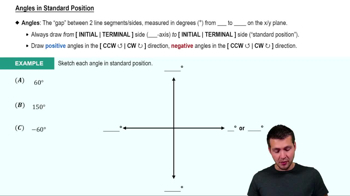
An angle is in standard position when its vertex is at the origin and its initial side lies along the positive x-axis. The terminal side is determined by rotating the initial side by the angle θ, measured counterclockwise for positive angles. Understanding this helps in visualizing and sketching the angle based on given conditions.
Recommended video:
05:50
Drawing Angles in Standard Position

Equation of the Terminal Side and Coordinate Restrictions

The equation x = 0 represents the y-axis, and the restriction y ≥ 0 limits the terminal side to the positive y-axis. This means the terminal side lies along the positive y-axis, corresponding to a specific angle θ. Recognizing this helps identify the exact angle and its position in the coordinate plane.
Recommended video:
05:32
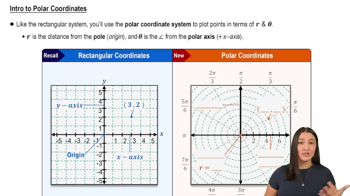
Intro to Polar Coordinates

Six Trigonometric Functions of an Angle

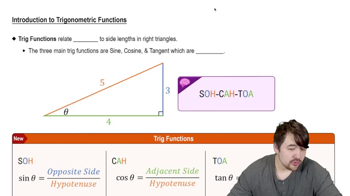
The six trigonometric functions—sine, cosine, tangent, cosecant, secant, and cotangent—are ratios of the coordinates of a point on the terminal side of the angle. For an angle on the positive y-axis, these functions can be found using the coordinates (x, y) on the terminal side, considering the radius (distance from origin) as the hypotenuse.
Recommended video:
6:04
Introduction to Trigonometric Functions