Textbook Question
In Exercises 81–86, solve each equation in the complex number system. Express solutions in polar and rectangular form. x⁶ − 1 = 0

 Blitzer 3rd EditionCh. 5 - Complex Numbers, Polar Coordinates and Parametric EquationsProblem 79
 Verified step by step guidance
 06:17
06:17
 2:25
2:25 4:08
4:08In Exercises 81–86, solve each equation in the complex number system. Express solutions in polar and rectangular form. x⁶ − 1 = 0
Find two different sets of parametric equations for y = x² + 6.
In Exercises 69–76, find all the complex roots. Write roots in rectangular form. If necessary, round to the nearest tenth. The complex sixth roots of 1 + i
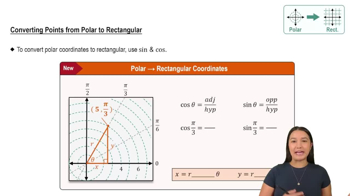
In Exercises 81–82, find the rectangular coordinates of each pair of points. Then find the distance, in simplified radical form, between the points. (2, 2π/3) and (4, π/6)
In Exercises 77–80, convert to polar form and then perform the indicated operations. Express answers in polar and rectangular form.
(1 + i√3)(1 − i)) / 2√3 − 2i
In Exercises 71–76, eliminate the parameter and graph the plane curve represented by the parametric equations. Use arrows to show the orientation of each plane curve. x = 3 + 2 cos t, y = 1+2 sin t; 0 ≤ t < 2π