Ch. 5 - Complex Numbers, Polar Coordinates and Parametric Equations
Blitzer - Trigonometry 3rd Edition
Blitzer3rd EditionTrigonometryISBN: 9780137316601Not the one you use?Change textbook
Chapter 5, Problem 5.RE.61

In Exercises 61–63, test for symmetry with respect to
a. the polar axis.
b. the line θ = π/2.
c. the pole.
r = 5 + 3 cos θ

Verified step by step guidance
1
Recall the tests for symmetry in polar coordinates: - Symmetry about the polar axis (the horizontal axis) means that if \( (r, \theta) \) is on the graph, then \( (r, -\theta) \) is also on the graph. - Symmetry about the line \( \theta = \frac{\pi}{2} \) means that if \( (r, \theta) \) is on the graph, then \( (r, \pi - \theta) \) is also on the graph. - Symmetry about the pole (origin) means that if \( (r, \theta) \) is on the graph, then \( (-r, \theta) \) or equivalently \( (r, \theta + \pi) \) is also on the graph.
To test symmetry about the polar axis, replace \( \theta \) with \( -\theta \) in the equation: \[ r = 5 + 3 \cos(-\theta) \] Use the even property of cosine, \( \cos(-\theta) = \cos \theta \), to simplify and check if the equation remains unchanged.
To test symmetry about the line \( \theta = \frac{\pi}{2} \), replace \( \theta \) with \( \pi - \theta \) in the equation: \[ r = 5 + 3 \cos(\pi - \theta) \] Use the identity \( \cos(\pi - \theta) = -\cos \theta \) to simplify and check if the resulting equation is equivalent to the original.
To test symmetry about the pole, replace \( r \) with \( -r \) and \( \theta \) with \( \theta + \pi \) in the equation: \[ -r = 5 + 3 \cos(\theta + \pi) \] Use the identity \( \cos(\theta + \pi) = -\cos \theta \) to simplify and check if this equation can be rearranged to the original form.
After performing these substitutions and simplifications, compare the resulting equations to the original equation to determine if the graph is symmetric with respect to each axis or the pole. If the equation remains unchanged or can be manipulated to the original form, the graph has that symmetry.

Verified video answer for a similar problem:

This video solution was recommended by our tutors as helpful for the problem above.
Video duration:
3m
Was this helpful?

Key Concepts

Here are the essential concepts you must grasp in order to answer the question correctly.

Symmetry with Respect to the Polar Axis

A polar graph is symmetric about the polar axis (the horizontal axis) if replacing θ with -θ in the equation yields the same equation. This means the graph looks identical above and below the polar axis, reflecting points across the horizontal line θ = 0.
Recommended video:
05:32
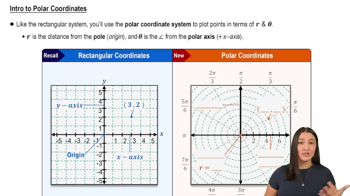
Intro to Polar Coordinates

Symmetry with Respect to the Line θ = π/2

Symmetry about the line θ = π/2 occurs if replacing θ with π - θ in the polar equation results in an equivalent equation. This tests whether the graph is mirrored across the vertical line through the pole at θ = 90°.
Recommended video:
2:22
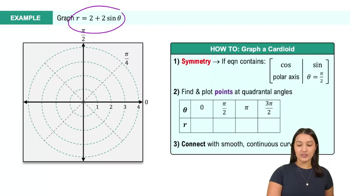
Cardioids Example 1

Symmetry with Respect to the Pole

A graph is symmetric about the pole (origin) if replacing r with -r and θ with θ + π produces the same equation. This means the graph is unchanged when points are reflected through the origin, indicating central symmetry.
Recommended video:
2:22
Cardioids Example 1