Ch. 5 - Complex Numbers, Polar Coordinates and Parametric Equations
Blitzer - Trigonometry 3rd Edition
Blitzer3rd EditionTrigonometryISBN: 9780137316601Not the one you use?Change textbook
Chapter 5, Problem 5.2.58

In Exercises 53–64, use DeMoivre's Theorem to find the indicated power of the complex number. Write answers in rectangular form. [1/2 (cos π/10 + i sin π/10)]⁵

Verified step by step guidance
1
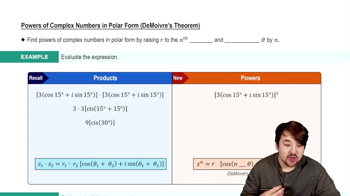
Recall DeMoivre's Theorem, which states that for a complex number in polar form \(r(\cos \theta + i \sin \theta)\), its \(n\)th power is given by \(r^n (\cos(n\theta) + i \sin(n\theta))\).
Identify the given complex number's modulus and argument: here, the modulus \(r = \frac{1}{2}\) and the argument \(\theta = \frac{\pi}{10}\).
Apply DeMoivre's Theorem to raise the complex number to the 5th power: compute \(r^5\) and multiply the argument by 5, so the expression becomes \(\left(\frac{1}{2}\right)^5 \left( \cos \left(5 \times \frac{\pi}{10} \right) + i \sin \left(5 \times \frac{\pi}{10} \right) \right)\).
Simplify the argument inside the trigonometric functions: \(5 \times \frac{\pi}{10} = \frac{5\pi}{10} = \frac{\pi}{2}\).
Write the final expression in rectangular form by evaluating \(\cos \frac{\pi}{2}\) and \(\sin \frac{\pi}{2}\), then multiply each by \(\left(\frac{1}{2}\right)^5\) to get the real and imaginary parts.

Verified video answer for a similar problem:

This video solution was recommended by our tutors as helpful for the problem above.
Video duration:
5m
Was this helpful?

Key Concepts

Here are the essential concepts you must grasp in order to answer the question correctly.

DeMoivre's Theorem

DeMoivre's Theorem states that for a complex number in polar form, (r(cos θ + i sin θ))^n = r^n (cos nθ + i sin nθ). It allows raising complex numbers to integer powers by multiplying the angle and raising the magnitude to the power, simplifying calculations.
Recommended video:
03:41
Powers Of Complex Numbers In Polar Form (DeMoivre's Theorem)

Polar and Rectangular Forms of Complex Numbers

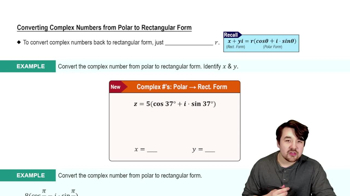
Complex numbers can be expressed in rectangular form (a + bi) or polar form (r(cos θ + i sin θ)). Converting between these forms is essential, especially after applying DeMoivre's Theorem, to write the final answer in the requested rectangular form.
Recommended video:
03:58
Converting Complex Numbers from Polar to Rectangular Form

Trigonometric Identities for Angle Multiplication

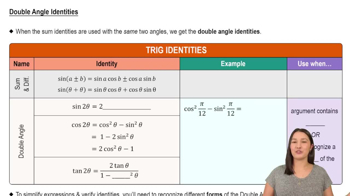
When applying DeMoivre's Theorem, the angle θ is multiplied by n. Understanding trigonometric identities and how to evaluate cos(nθ) and sin(nθ) accurately is crucial for simplifying the expression and converting it back to rectangular form.
Recommended video:
05:06
Double Angle Identities