Ch. 5 - Complex Numbers, Polar Coordinates and Parametric Equations
Blitzer - Trigonometry 3rd Edition
Blitzer3rd EditionTrigonometryISBN: 9780137316601Not the one you use?Change textbook
Chapter 5, Problem 5.2.49

In Exercises 45–52, find the quotient z₁/z₂ of the complex numbers. Leave answers in polar form. In Exercises 49–50, express the argument as an angle between 0° and 360°.
z₁ = cos 80° + i sin 80°
z₂ = cos 200° + i sin 200°

Verified step by step guidance
1
Recognize that the complex numbers are given in polar form using Euler's formula: \(z = \cos \theta + i \sin \theta\) corresponds to \(z = r(\cos \theta + i \sin \theta)\) with \(r=1\) here.
Recall the formula for dividing two complex numbers in polar form: if \(z_1 = r_1 (\cos \theta_1 + i \sin \theta_1)\) and \(z_2 = r_2 (\cos \theta_2 + i \sin \theta_2)\), then their quotient is \(\frac{z_1}{z_2} = \frac{r_1}{r_2} \left( \cos(\theta_1 - \theta_2) + i \sin(\theta_1 - \theta_2) \right)\).
Identify the magnitudes and arguments of \(z_1\) and \(z_2\): both have magnitude \(r_1 = r_2 = 1\), and arguments \(\theta_1 = 80^\circ\), \(\theta_2 = 200^\circ\).
Calculate the magnitude of the quotient: \(\frac{r_1}{r_2} = \frac{1}{1} = 1\).
Calculate the argument of the quotient: \(\theta = \theta_1 - \theta_2 = 80^\circ - 200^\circ = -120^\circ\). Since the problem asks for an angle between \(0^\circ\) and \(360^\circ\), add \(360^\circ\) to get \(240^\circ\). Thus, the quotient in polar form is \(1 \left( \cos 240^\circ + i \sin 240^\circ \right)\).

Verified video answer for a similar problem:

This video solution was recommended by our tutors as helpful for the problem above.
Video duration:
4m
Was this helpful?

Key Concepts

Here are the essential concepts you must grasp in order to answer the question correctly.

Complex Numbers in Polar Form

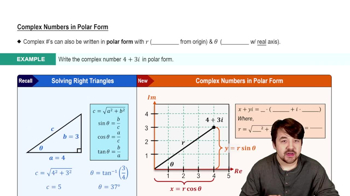
Complex numbers can be represented in polar form as r(cos θ + i sin θ), where r is the magnitude and θ is the argument (angle). This form simplifies multiplication and division by working directly with magnitudes and angles instead of real and imaginary parts.
Recommended video:
04:47
Complex Numbers In Polar Form

Division of Complex Numbers in Polar Form

To divide two complex numbers in polar form, divide their magnitudes and subtract the arguments: (r₁∠θ₁) / (r₂∠θ₂) = (r₁/r₂) ∠ (θ₁ - θ₂). This method avoids complicated algebraic manipulation and yields the quotient in polar form.
Recommended video:
04:47
Complex Numbers In Polar Form

Argument of a Complex Number and Angle Normalization

The argument of a complex number is the angle it makes with the positive real axis. When expressing the argument, it is often normalized to lie within 0° to 360° by adding or subtracting full rotations (360°) to ensure a positive angle measurement.
Recommended video:
4:22
Dividing Complex Numbers