In Exercises 53–64, use DeMoivre's Theorem to find the indicated power of the complex number. Write answers in rectangular form. [2(cos 80° + i sin 80°)]³
Ch. 5 - Complex Numbers, Polar Coordinates and Parametric Equations

All textbooks
Blitzer 3rd Edition
Ch. 5 - Complex Numbers, Polar Coordinates and Parametric Equations
Problem 5.3.45
Blitzer 3rd Edition
Ch. 5 - Complex Numbers, Polar Coordinates and Parametric Equations
Problem 5.3.45Chapter 5, Problem 5.3.45
In Exercises 41–48, the rectangular coordinates of a point are given. Find polar coordinates of each point. Express θ in radians. (−√3,−1)
Verified step by step guidance1
Recall that to convert rectangular coordinates \((x, y)\) to polar coordinates \((r, \theta)\), we use the formulas: \(r = \sqrt{x^2 + y^2}\) and \(\theta = \arctan\left(\frac{y}{x}\right)\).
Calculate the radius \(r\) by substituting \(x = -\sqrt{3}\) and \(y = -1\) into the formula: \(r = \sqrt{(-\sqrt{3})^2 + (-1)^2}\).
Find the initial angle \(\theta\) by computing \(\arctan\left(\frac{y}{x}\right) = \arctan\left(\frac{-1}{-\sqrt{3}}\right)\), which simplifies to \(\arctan\left(\frac{1}{\sqrt{3}}\right)\).
Determine the correct quadrant for \(\theta\). Since both \(x\) and \(y\) are negative, the point lies in the third quadrant, so adjust \(\theta\) accordingly by adding \(\pi\) radians to the reference angle.
Express the final polar coordinates as \((r, \theta)\) with \(r\) positive and \(\theta\) in radians, ensuring \(\theta\) is between \(0\) and \(2\pi\).

Verified video answer for a similar problem:
This video solution was recommended by our tutors as helpful for the problem above.
Video duration:
5mWas this helpful?
Key Concepts
Here are the essential concepts you must grasp in order to answer the question correctly.
Rectangular and Polar Coordinates
Rectangular coordinates (x, y) represent a point's position on the Cartesian plane using horizontal and vertical distances. Polar coordinates (r, θ) describe the same point by its distance r from the origin and the angle θ it makes with the positive x-axis, measured in radians.
Recommended video:
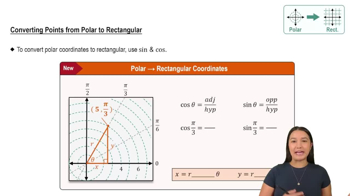
Convert Points from Polar to Rectangular
Conversion Formulas Between Coordinates
To convert from rectangular to polar coordinates, use r = √(x² + y²) to find the radius and θ = arctan(y/x) to find the angle. Adjust θ based on the quadrant of the point to ensure the angle correctly represents the point's direction.
Recommended video:
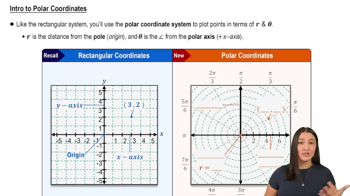
Intro to Polar Coordinates
Angle Measurement in Radians and Quadrant Considerations
Angles in polar coordinates are measured in radians, where 2π radians equal 360°. Since arctan(y/x) returns values between -π/2 and π/2, you must consider the signs of x and y to determine the correct quadrant and adjust θ accordingly for accurate representation.
Recommended video:
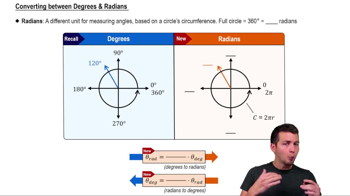
Converting between Degrees & Radians
Related Practice
Textbook Question
Textbook Question
In Exercises 1–10, perform the indicated operations and write the result in standard form. (7 + 8i)(7 − 8i)
Textbook Question
In Exercises 49–58, convert each rectangular equation to a polar equation that expresses r in terms of θ. x² + y² = 9
Textbook Question
In Exercises 53–64, use DeMoivre's Theorem to find the indicated power of the complex number. Write answers in rectangular form. [2(cos 10° + i sin 10°)]³
2
views
Textbook Question
In Exercises 53–58, perform the indicated operation(s) and write the result in standard form. (2 − 3i)(1 − i) − (3 − i)(3 + i)
6
views
Textbook Question
In Exercises 53–56, find two different sets of parametric equations for each rectangular equation. y = x² + 4
1
views