Ch. 5 - Complex Numbers, Polar Coordinates and Parametric Equations
Blitzer - Trigonometry 3rd Edition
Blitzer3rd EditionTrigonometryISBN: 9780137316601Not the one you use?Change textbook
Chapter 5, Problem 19

In Exercises 13–34, test for symmetry and then graph each polar equation. r = 2 + cos θ

Verified step by step guidance
1
Recall the three common tests for symmetry in polar coordinates: symmetry about the polar axis (x-axis), symmetry about the line \( \theta = \frac{\pi}{2} \) (y-axis), and symmetry about the pole (origin).
To test symmetry about the polar axis, replace \( \theta \) with \( -\theta \) in the equation and check if the equation remains unchanged. For \( r = 2 + \cos \theta \), substitute \( -\theta \) to get \( r = 2 + \cos(-\theta) \). Since \( \cos(-\theta) = \cos \theta \), the equation is unchanged, so the graph is symmetric about the polar axis.
To test symmetry about the line \( \theta = \frac{\pi}{2} \), replace \( \theta \) with \( \pi - \theta \) and check if the equation remains unchanged. Substitute \( \pi - \theta \) into the equation: \( r = 2 + \cos(\pi - \theta) \). Use the identity \( \cos(\pi - \theta) = -\cos \theta \) to rewrite it as \( r = 2 - \cos \theta \). Since this is not the same as the original equation, the graph is not symmetric about the line \( \theta = \frac{\pi}{2} \).
To test symmetry about the pole (origin), replace \( r \) with \( -r \) and \( \theta \) with \( \theta + \pi \), then check if the equation remains unchanged. Substitute to get \( -r = 2 + \cos(\theta + \pi) \). Using \( \cos(\theta + \pi) = -\cos \theta \), this becomes \( -r = 2 - \cos \theta \), or equivalently \( r = -2 + \cos \theta \). Since this differs from the original equation, the graph is not symmetric about the pole.
After determining the symmetries, sketch the graph by plotting points for various values of \( \theta \) between 0 and \( 2\pi \), calculating \( r = 2 + \cos \theta \) for each, and then plotting these points in polar coordinates. Connect the points smoothly to visualize the curve.

Verified video answer for a similar problem:

This video solution was recommended by our tutors as helpful for the problem above.
Video duration:
6m
Was this helpful?

Key Concepts

Here are the essential concepts you must grasp in order to answer the question correctly.

Polar Coordinates and Equations

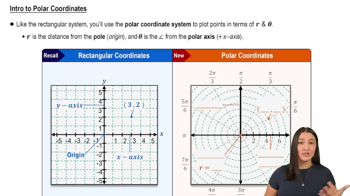
Polar coordinates represent points using a radius r and an angle θ from the positive x-axis. Polar equations express r as a function of θ, describing curves in the plane. Understanding how to interpret and plot these equations is essential for graphing polar curves.
Recommended video:
05:32
Intro to Polar Coordinates

Symmetry Tests in Polar Graphs

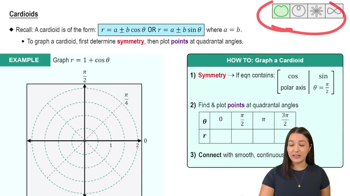
Symmetry in polar graphs can be tested about the polar axis, the line θ = π/2, and the pole (origin). These tests involve substituting θ with -θ, π - θ, or replacing r with -r to check if the equation remains unchanged, helping to simplify graphing and understand the curve's shape.
Recommended video:
3:19
Cardioids

Graphing Polar Equations Involving Cosine

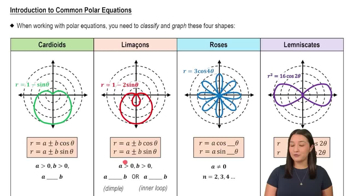
Polar equations with cosine terms, like r = 2 + cos θ, often produce limaçon shapes. Recognizing how the cosine function affects the radius for different θ values aids in plotting key points and sketching the curve accurately, including identifying loops or dimpled features.
Recommended video:
3:47
Introduction to Common Polar Equations