Textbook Question
In Exercises 22–24, find the quotient z₁/z₂ of the complex numbers. Leave answers in polar form.
z₁ = 5 (cos 4π/3 + i sin 4π/3)
z₂ = 10 (cos π/3 + i sin π/3)

 Blitzer 3rd EditionCh. 5 - Complex Numbers, Polar Coordinates and Parametric EquationsProblem 23
 Verified step by step guidance
 05:32
05:32
 3:19
3:19 3:47
3:47In Exercises 22–24, find the quotient z₁/z₂ of the complex numbers. Leave answers in polar form.
z₁ = 5 (cos 4π/3 + i sin 4π/3)
z₂ = 10 (cos π/3 + i sin π/3)
In Exercises 11–26, plot each complex number. Then write the complex number in polar form. You may express the argument in degrees or radians. −3 + 4i
In Exercises 21–28, divide and express the result in standard form. 2 / 3 - i
In Exercises 21–28, divide and express the result in standard form.
3 / 4+i
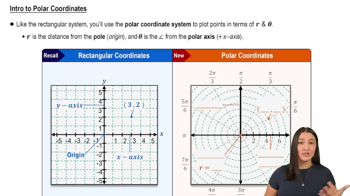
In Exercises 21–26, use a polar coordinate system like the one shown for Exercises 1–10 to plot each point with the given polar coordinates. Then find another representation of this point in which
a. r>0, 2π < θ < 4π.
b. r<0, 0. < θ < 2π.
c. r>0, −2π. < θ < 0.
(5, π/6)
In Exercises 21–26, use a polar coordinate system like the one shown for Exercises 1–10 to plot each point with the given polar coordinates. Then find another representation of this point in which a. r>0, 2π < θ < 4π. b. r<0, 0. < θ < 2π. c. r>0, −2π. < θ < 0. (4, π/2)