Ch. 5 - Complex Numbers, Polar Coordinates and Parametric Equations
Blitzer - Trigonometry 3rd Edition
Blitzer3rd EditionTrigonometryISBN: 9780137316601Not the one you use?Change textbook
Chapter 5, Problem 31

In Exercises 13–34, test for symmetry and then graph each polar equation. r = 1 − 3 sin θ

Verified step by step guidance
1
Recall that to test for symmetry in polar equations, we check three types: symmetry about the polar axis (x-axis), symmetry about the line \( \theta = \frac{\pi}{2} \) (y-axis), and symmetry about the pole (origin).
For symmetry about the polar axis, replace \( \theta \) with \( -\theta \) in the equation and see if the equation remains unchanged. That is, check if \( r = 1 - 3 \sin(-\theta) \) simplifies to the original equation.
For symmetry about the line \( \theta = \frac{\pi}{2} \), replace \( \theta \) with \( \pi - \theta \) and check if the equation remains unchanged. So, check if \( r = 1 - 3 \sin(\pi - \theta) \) simplifies to the original equation.
For symmetry about the pole, replace \( r \) with \( -r \) and \( \theta \) with \( \theta + \pi \), then check if the equation remains unchanged. That is, check if \( -r = 1 - 3 \sin(\theta + \pi) \) can be rearranged to the original form.
After determining the symmetries, sketch the graph by plotting points for various values of \( \theta \) between 0 and \( 2\pi \), using the equation \( r = 1 - 3 \sin \theta \), and then reflect the graph according to the symmetries found.

Verified video answer for a similar problem:

This video solution was recommended by our tutors as helpful for the problem above.
Video duration:
6m
Was this helpful?

Key Concepts

Here are the essential concepts you must grasp in order to answer the question correctly.

Polar Coordinates and Equations

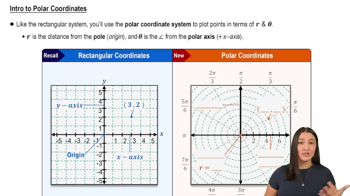
Polar coordinates represent points using a radius r and an angle θ from the positive x-axis. Polar equations express r as a function of θ, describing curves in the plane. Understanding how to interpret and plot these equations is essential for graphing polar curves.
Recommended video:
05:32
Intro to Polar Coordinates

Symmetry Tests in Polar Graphs

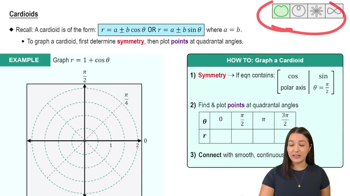
Symmetry in polar graphs can be tested about the polar axis, the line θ = π/2, and the pole (origin). These tests involve substituting θ with -θ, π - θ, or replacing r with -r to check if the equation remains unchanged, helping to identify symmetrical properties of the curve.
Recommended video:
3:19
Cardioids

Graphing Polar Equations Involving Sine

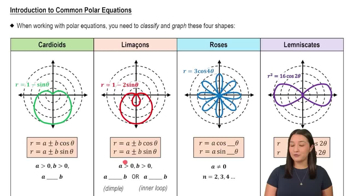
Polar equations with sine functions, like r = 1 - 3 sin θ, often produce limaçon or cardioid shapes. Recognizing the effect of the sine term on the radius as θ varies aids in sketching the curve accurately, including identifying loops, petals, or inner loops.
Recommended video:
3:47
Introduction to Common Polar Equations