Ch. 4 - Laws of Sines and Cosines; Vectors
Blitzer - Trigonometry 3rd Edition
Blitzer3rd EditionTrigonometryISBN: 9780137316601Not the one you use?Change textbook
Chapter 4, Problem 43

In Exercises 43–44, find the angle, in degrees, between v and w.
v = 2 cos(4π/3) i + 2 sin(4π/3) j, w = 3 cos(3π/2) i + 3 sin(3π/2) j

Verified step by step guidance
1
Identify the vectors \( \mathbf{v} = 2 \cos(4\pi) \mathbf{i} + 2 \sin(4\pi) \mathbf{j} \) and \( \mathbf{w} = 3 \cos(3\pi) \mathbf{i} + 3 \sin(3\pi) \mathbf{j} \). These are given in component form using trigonometric functions.
Recall that the angle \( \theta \) between two vectors \( \mathbf{v} \) and \( \mathbf{w} \) can be found using the dot product formula: \[ \mathbf{v} \cdot \mathbf{w} = \|\mathbf{v}\| \|\mathbf{w}\| \cos(\theta) \] which rearranges to \[ \theta = \cos^{-1} \left( \frac{\mathbf{v} \cdot \mathbf{w}}{\|\mathbf{v}\| \|\mathbf{w}\|} \right) \].
Calculate the components of \( \mathbf{v} \) and \( \mathbf{w} \) by evaluating the cosine and sine values at the given angles: - \( \cos(4\pi) \) and \( \sin(4\pi) \) - \( \cos(3\pi) \) and \( \sin(3\pi) \).
Compute the dot product \( \mathbf{v} \cdot \mathbf{w} \) using the formula: \[ \mathbf{v} \cdot \mathbf{w} = v_x w_x + v_y w_y \] where \( v_x, v_y \) and \( w_x, w_y \) are the components of \( \mathbf{v} \) and \( \mathbf{w} \) respectively.
Find the magnitudes \( \|\mathbf{v}\| \) and \( \|\mathbf{w}\| \) using: \[ \|\mathbf{v}\| = \sqrt{v_x^2 + v_y^2} \quad \text{and} \quad \|\mathbf{w}\| = \sqrt{w_x^2 + w_y^2} \] Finally, substitute these values into the formula for \( \theta \) and solve for the angle in degrees.

Verified video answer for a similar problem:

This video solution was recommended by our tutors as helpful for the problem above.
Video duration:
12m
Was this helpful?

Key Concepts

Here are the essential concepts you must grasp in order to answer the question correctly.

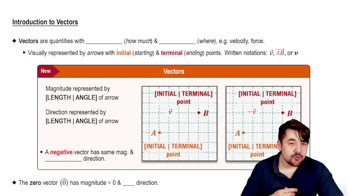
Vector Representation in the Plane

Vectors in the plane can be expressed using their components along the i (x-axis) and j (y-axis) unit vectors. Here, each vector is given in terms of cosine and sine functions, which correspond to the x and y components based on an angle from the positive x-axis. Understanding this allows you to interpret the vectors geometrically and perform calculations.
Recommended video:
03:48
Introduction to Vectors

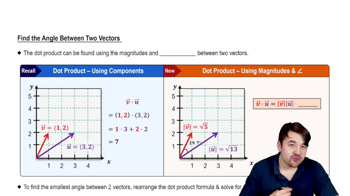
Dot Product and Angle Between Vectors

The dot product of two vectors relates their magnitudes and the cosine of the angle between them: v · w = |v||w|cos(θ). By computing the dot product and magnitudes, you can solve for the angle θ between vectors. This is essential for finding the angle in degrees between v and w.
Recommended video:
04:33
Find the Angle Between Vectors

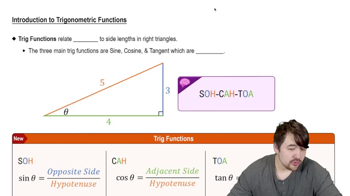
Trigonometric Functions and Angle Measures

Cosine and sine functions describe the coordinates of points on the unit circle at given angles, often in radians. Converting these angles and understanding their periodicity helps simplify vector components and calculate exact values. Recognizing angles like 3π and 4π radians is key to evaluating the vector components correctly.
Recommended video:
6:04
Introduction to Trigonometric Functions