Ch. 4 - Laws of Sines and Cosines; Vectors
Blitzer - Trigonometry 3rd Edition
Blitzer3rd EditionTrigonometryISBN: 9780137316601Not the one you use?Change textbook
Chapter 4, Problem 31

In Exercises 21–38, let u = 2i - 5j, v = -3i + 7j, and w = -i - 6j. Find each specified vector or scalar.
3w + 2v

Verified step by step guidance
1
Identify the given vectors: \( \mathbf{u} = 2\mathbf{i} - 5\mathbf{j} \), \( \mathbf{v} = -3\mathbf{i} + 7\mathbf{j} \), and \( \mathbf{w} = -\mathbf{i} - 6\mathbf{j} \).
Calculate the scalar multiplication of vector \( \mathbf{w} \) by 3: multiply each component of \( \mathbf{w} \) by 3, resulting in \( 3\mathbf{w} = 3(-\mathbf{i}) + 3(-6\mathbf{j}) \).
Calculate the scalar multiplication of vector \( \mathbf{v} \) by 2: multiply each component of \( \mathbf{v} \) by 2, resulting in \( 2\mathbf{v} = 2(-3\mathbf{i}) + 2(7\mathbf{j}) \).
Add the resulting vectors from the previous two steps component-wise: add the \( \mathbf{i} \) components together and the \( \mathbf{j} \) components together to find \( 3\mathbf{w} + 2\mathbf{v} \).
Write the final vector in the form \( a\mathbf{i} + b\mathbf{j} \), where \( a \) and \( b \) are the sums of the respective components.

Verified video answer for a similar problem:

This video solution was recommended by our tutors as helpful for the problem above.
Video duration:
2m
Was this helpful?

Key Concepts

Here are the essential concepts you must grasp in order to answer the question correctly.

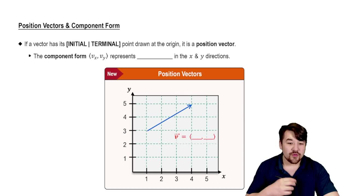
Vector Representation in Component Form

Vectors in two dimensions can be expressed as a combination of unit vectors i and j, representing the x and y components respectively. For example, u = 2i - 5j means the vector has an x-component of 2 and a y-component of -5. Understanding this form allows for straightforward vector addition and scalar multiplication.
Recommended video:
03:55
Position Vectors & Component Form

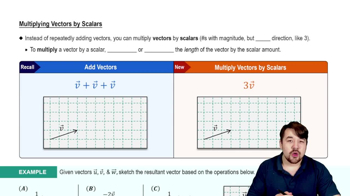
Scalar Multiplication of Vectors

Scalar multiplication involves multiplying each component of a vector by a scalar (a real number). For instance, multiplying vector w by 3 means multiplying both its i and j components by 3, resulting in a new vector scaled in magnitude but with the same direction if the scalar is positive.
Recommended video:
05:05
Multiplying Vectors By Scalars

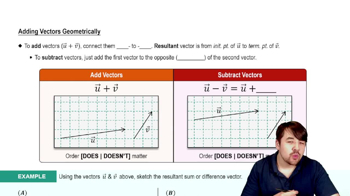
Vector Addition

Vector addition is performed by adding corresponding components of two vectors. For example, adding 2v and 3w requires adding the x-components of 2v and 3w together, and similarly for the y-components, resulting in a new vector that combines both directions and magnitudes.
Recommended video:
05:29
Adding Vectors Geometrically